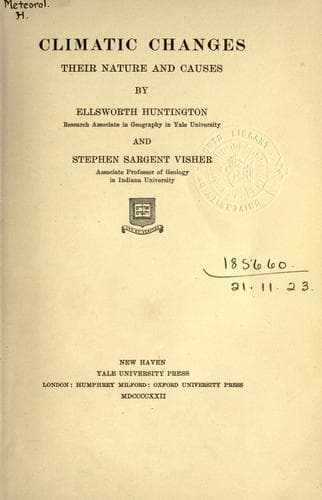
Climatic Changes: Their Nature and CausesHuntington, Ellsworth
Science
Climatic Changes: Their Nature and Causes
Huntington, Ellsworth
Climatic changes; Climatology; Paleoclimatology
(2) Increased salinity means a lower freezing temperature of the oceans
and hence would have an effect during cold periods such as the present
and the Pleistocene ice age. It would not, however, be of importance
during the long warm periods which form most of geologic time. A
salinity of about 3.5 per cent at present lowers the freezing point of
the ocean roughly 2 deg.C. below that of fresh water. If the ocean were
fresh and our winters as cold as now, all the harbors of New England and
the Middle Atlantic States would be icebound. The Baltic Sea would also
be frozen each winter, and even the eastern harbors of the British Isles
would be frequently locked in ice. At high latitudes the area of
permanently frozen oceans would be much enlarged. The effect of such a
condition upon marine life in high latitudes would be like that of a
change to a warmer climate. It would protect the life on the continental
shelf from the severe battering of winter storms. It would also lessen
the severity of the winter temperature in the water for when water
freezes it gives up much latent heat,--eighty calories per cubic
centimeter. Part of this raises the temperature of the underlying water.
The expansion of the ice near northern shores would influence the life
of the lands quite differently from that of the oceans. It would act
like an addition of land to the continents and would, therefore,
increase the atmospheric contrasts from zone to zone and from
continental interior to ocean. In summer the ice upon the sea would tend
to keep the coastal lands cool, very much as happens now near the Arctic
Ocean, where the ice floes have a great effect through their reflection
of light and their absorption of heat in melting. In winter the virtual
enlargement of the continents by the addition of an ice fringe would
decrease the snowfall upon the lands. Still more important would be the
effect in intensifying the anti-cyclonic conditions which normally
prevail in winter not only over continents but over ice-covered oceans.
Hence the outblowing cold winds would he strengthened.[98] The net
effect of all these conditions would apparently be a diminution of
snowfall in high latitudes upon the lands even though the summer
snowfall upon the ocean and the coasts may have increased. This
condition may have been one reason why widespread glaciation does not
appear to have prevailed in high latitudes during the Proterozoic and
Permian glaciations, even though it occurred farther south. If the ocean
during those early glacial epochs were ice-covered down to middle
latitudes, a lack of extensive glaciation in high latitudes would be no
more surprising than is the lack of Pleistocene glaciation in the
northern parts of Alaska and Asia. Great ice sheets are impossible
without a large supply of moisture.
Public-domain text, read in full here on John Shaqi.
Reviews
Reviews
No reviews yet
Be the first to share your thoughts on this work.
Elsewhere in the archive
Join the Discussion
Join the discussion
Sign in to leave a comment or review.
Sign InorCreate an account