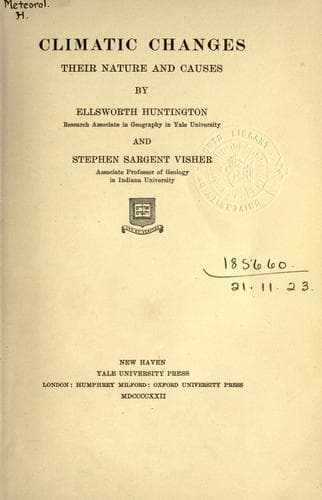
Climatic Changes: Their Nature and CausesHuntington, Ellsworth
Science
Climatic Changes: Their Nature and Causes
Huntington, Ellsworth
Climatic changes; Climatology; Paleoclimatology
The meaning of cosmic uniformity has been explained in the preceding
chapter. Its relation to the other types of climatic sequences seems to
be that it sets sharply defined limits beyond which no changes of any
kind have ever gone since life, as we know it, first began. Secular
progression, on the other hand, means that in spite of all manner of
variations, now this way and then the other, the normal climate of the
earth, if there is such a thing, has on the whole probably changed a
little, perhaps becoming more complex. After each period of continental
uplift and glaciation--for such are preeminently the times of
complexity--it is doubtful whether the earth has ever returned to quite
its former degree of monotony. Today the earth has swung away from the
great diversity of the glacial period. Yet we still have contrasts of
what seem to us great magnitude. In low depressions, such as Turfan in
the central deserts of Eurasia, the thermometer sometimes ranges from
0 deg.F. in the morning to 60 deg. in the shade at noon. On a cloudy day in the
Amazon forest close to the seashore, on the contrary, the temperature
for months may rise to 85 deg. by day and sink no lower than 75 deg. at night.
The reasons for the secular progression of the earth's climate appear to
be intimately connected with those which have caused the next, and, in
many respects, more important type of climatic sequence, which consists
of geological oscillations. Both the progression and the oscillations
seem to depend largely on three purely terrestrial factors: first, the
condition of the earth's interior, including both internal heat and
contraction; second, the salinity and movement of the ocean; and third,
the composition and amount of the atmosphere. To begin with the earth's
interior--its loss of heat appears to be an almost negligible factor in
explaining either secular progression or geologic oscillation. According
to both the nebular and the planetesimal hypotheses, the earth's crust
appears to be colder now than it was hundreds or thousands of millions
of years ago. The emission of internal heat, however, had probably
ceased to be of much climatic significance near the beginning of the
geological record, for in southern Canada glaciation occurred very early
in the Proterozoic era. On the other hand, the contraction of the earth
has produced remarkable effects throughout the whole of geological time.
It has lessened the earth's circumference by a thousand miles or more,
as appears from the way in which the rocks have been folded and thrust
bodily over one another. According to the laws of dynamics this must
have increased the speed of the earth's rotation, thus shortening the
day, and also having the more important effect of increasing the bulge
at the equator. On the other hand, recent investigations indicate that
tidal retardation has probably diminished the earth's rate of rotation
more than seemed probable a few years ago, thus lengthening the day and
Public-domain text, read in full here on John Shaqi.
Reviews
Reviews
No reviews yet
Be the first to share your thoughts on this work.
Join the Discussion
Join the discussion
Sign in to leave a comment or review.
Sign InorCreate an account