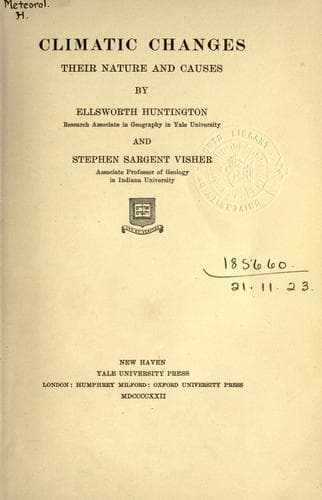
Climatic Changes: Their Nature and CausesHuntington, Ellsworth
Science
Climatic Changes: Their Nature and Causes
Huntington, Ellsworth
Climatic changes; Climatology; Paleoclimatology
diminishing the bulge at the equator. Thus two opposing forces have been
at work, one causing acceleration and one retardation. Their combined
effect may have been a factor in causing secular progression of climate.
It almost certainly was of much importance in causing pronounced
oscillations first one way and then the other. This matter, together
with most of those touched in these first chapters, will be expanded in
later parts of the book. On the whole the tendency appears to have been
to create climatic diversity in place of uniformity.
The increasing salinity of the oceans may have been another factor in
producing secular progression, although of slight importance in respect
to oscillations. While the oceans were still growing in volume, it is
generally assumed that they must have been almost fresh for a vast
period, although Chamberlin thinks that the change in salinity has been
much less than is usually supposed. So far as the early oceans were
fresher than those of today, their deep-sea circulation must have been
less hampered than now by the heavy saline water which is produced by
evaporation in warm regions. Although this saline water is warm, its
weight causes it to descend, instead of moving poleward in a surface
current; this descent slows up the rise of the cold water which has
moved along in the depths of the ocean from high latitudes, and thus
checks the general oceanic circulation. If the ancient oceans were
fresher and hence had a freer circulation than now, a more rapid
interchange of polar and equatorial water presumably tended to equalize
the climate of all latitudes.
Public-domain text, read in full here on John Shaqi.
Reviews
Reviews
No reviews yet
Be the first to share your thoughts on this work.
Join the Discussion
Join the discussion
Sign in to leave a comment or review.
Sign InorCreate an account