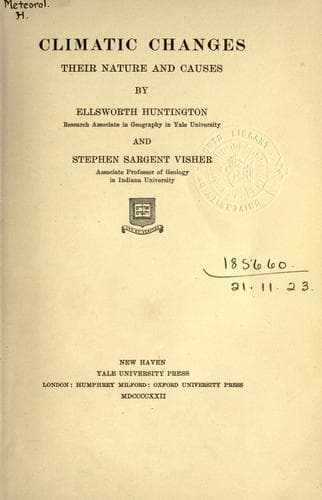
Climatic Changes: Their Nature and CausesHuntington, Ellsworth
Science
Climatic Changes: Their Nature and Causes
Huntington, Ellsworth
Climatic changes; Climatology; Paleoclimatology
The combined effect of the various means of increase and decrease
depends partly on the amount of each constituent received from the
earth's interior or from space, and partly on the fact that the agencies
which tend to deplete the atmosphere are highly selective in their
action. Our knowledge of how large a quantity of new gases the air has
received is very scanty, but judging by present conditions the general
tendency is toward a slow increase chiefly because of meteorites,
volcanic action, and the work of deep-seated springs. As to decrease,
the case is clearer. This is because the chemically active gases,
oxygen, CO_{2}, and water vapor, tend to be locked up in the rocks,
while the chemically inert gases, nitrogen and argon, show almost no
such tendency. Though oxygen is by far the most abundant element in the
earth's crust, making up more than 50 per cent of the total, it forms
only about one-fifth of the air. Nitrogen, on the other hand, is very
rare in the rocks, but makes up nearly four-fifths of the air. It would,
therefore, seem probable that throughout the earth's history, there has
been a progressive increase in the amount of atmospheric nitrogen, and
presumably a somewhat corresponding increase in the mass of the air. On
the other hand, it is not clear what changes have occurred in the amount
of atmospheric oxygen. It may have increased somewhat or perhaps even
notably. Nevertheless, because of the greater increase in nitrogen, it
may form no greater percentage of the air now than in the distant past.
Public-domain text, read in full here on John Shaqi.
Reviews
Reviews
No reviews yet
Be the first to share your thoughts on this work.
Elsewhere in the archive
Join the Discussion
Join the discussion
Sign in to leave a comment or review.
Sign InorCreate an account