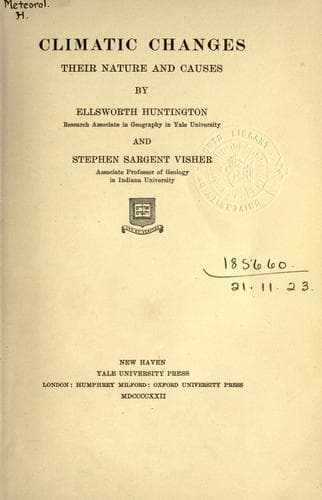
Climatic Changes: Their Nature and CausesHuntington, Ellsworth
Science
Climatic Changes: Their Nature and Causes
Huntington, Ellsworth
Climatic changes; Climatology; Paleoclimatology
As to the absolute amounts of oxygen, Barrell[107] thought that
atmospheric oxygen began to be present only after plants had appeared.
It will be recalled that plants absorb carbon dioxide and separate the
carbon from the oxygen, using the carbon in their tissues and setting
free the oxygen. As evidence of a paucity of oxygen in the air in early
Proterozoic times, Barrell cites the fact that the sedimentary rocks of
that remote time commonly are somewhat greyish or greenish-grey wackes,
or other types, indicating incomplete oxidation. He admits, however,
that the stupendous thicknesses of red sandstones, quartzite, and
hematitic iron ores of the later Proterozoic prove that by that date
there was an abundance of atmospheric oxygen. If so, the change from
paucity to abundance must have occurred before fossils were numerous
enough to give much clue to climate. However, Barrell's evidence as to
a former paucity of atmospheric oxygen is not altogether convincing. In
the first place, it does not seem justifiable to assume that there could
be no oxygen until plants appeared to break down the carbon dioxide, for
some oxygen is contributed by volcanoes,[108] and lightning decomposes
water into its elements. Part of the hydrogen thus set free escapes into
space, for the earth's gravitative force does not appear great enough to
hold this lightest of gases, but the oxygen remains. Thus electrolysis
of water results in the accumulation of oxygen. In the second place,
there is no proof that the ancient greywackes are not deoxidized
sediments. Light colored rock formations do not necessarily indicate
a paucity of atmospheric oxygen, for such rocks are abundant
even in recent times. For example, the Tertiary formations are
characteristically light colored, a result, however, of deoxidation.
Finally, the fact that sedimentary rocks, irrespective of their age,
contain an average of about 1.5 per cent more oxygen than do igneous
rocks,[109] suggests that oxygen was present in the air in quantity even
when the earliest shales and sandstones were formed, for atmospheric
oxygen seems to be the probable source of the extra oxygen they contain.
The formation of these particular sedimentary rocks by weathering of
igneous rocks involves only a little carbon dioxide and water. Although
it seems probable that oxygen was present in the atmosphere even at the
beginning of the geological record, it may have been far less abundant
then than now. It may have been removed from the atmosphere by animals
or by the oxidation of the rocks almost as rapidly as it was added by
volcanoes, plants, and other agencies.
Public-domain text, read in full here on John Shaqi.
Reviews
Reviews
No reviews yet
Be the first to share your thoughts on this work.
Elsewhere in the archive
Join the Discussion
Join the discussion
Sign in to leave a comment or review.
Sign InorCreate an account