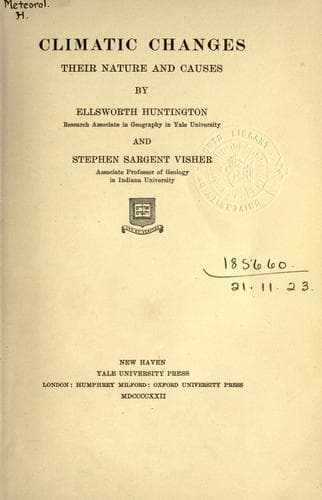
Climatic Changes: Their Nature and CausesHuntington, Ellsworth
Science
Climatic Changes: Their Nature and Causes
Huntington, Ellsworth
Climatic changes; Climatology; Paleoclimatology
After this chapter was in type, St. John[C] announced his interesting
discovery that oxygen is apparently lacking in the atmosphere of Venus.
He considers that this proves that Venus has no life. Furthermore he
concludes that so active an element as oxygen cannot be abundant in the
atmosphere of a planet unless plants continually supply large quantities
by breaking down carbon dioxide.
But even if the earth has experienced a notable increase in atmospheric
oxygen since the appearance of life, this does not necessarily involve
important climatic changes except those due to increased atmospheric
density. This is because oxygen has very little effect upon the passage
of light or heat, being transparent to all but a few wave lengths. Those
absorbed are chiefly in the ultra violet.
The distinct possibility that oxygen has increased in amount, makes it
the more likely that there has been an increase in the total atmosphere,
for the oxygen would supplement the increase in the relatively inert
nitrogen and argon, which has presumably taken place. The climatic
effects of an increase in the atmosphere include, in the first place, an
increased scattering of light as it approaches the earth. Nitrogen,
argon, and oxygen all scatter the short waves of light and thus
interfere with their reaching the earth. Abbot and Fowle,[110] who have
carefully studied the matter, believe that at present the scattering is
quantitatively important in lessening insolation. Hence our supposed
general increase in the volume of the air during part of geological
times would tend to reduce the amount of solar energy reaching the
earth's surface. On the other hand, nitrogen and argon do not appear to
absorb the long wave lengths known as heat, and oxygen absorbs so little
as to be almost a non-absorber. Therefore the reduced penetration of the
air by solar radiation due to the scattering of light would apparently
not be neutralized by any direct increase in the blanketing effect of
the atmosphere, and the temperature near the earth's surface would be
slightly lowered by a thicker atmosphere. This would diminish the amount
of water vapor which would be held in the air, and thereby lower the
temperature a trifle more.
Public-domain text, read in full here on John Shaqi.
Reviews
Reviews
No reviews yet
Be the first to share your thoughts on this work.
Elsewhere in the archive
Join the Discussion
Join the discussion
Sign in to leave a comment or review.
Sign InorCreate an account