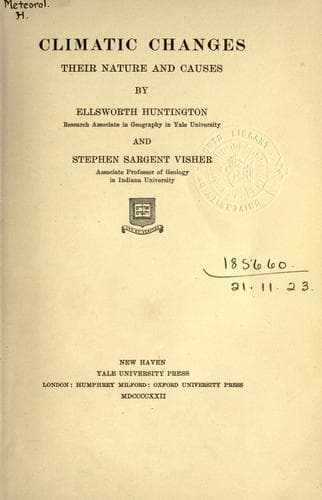
Climatic Changes: Their Nature and CausesHuntington, Ellsworth
Science
Climatic Changes: Their Nature and Causes
Huntington, Ellsworth
Climatic changes; Climatology; Paleoclimatology
In the second place, the higher atmospheric pressure which would result
from the addition of gases to the air would cause a lessening of the
rate of evaporation, for that rate declines as pressure increases.
Decreased evaporation would presumably still further diminish the vapor
content of the atmosphere. This would mean a greater daily and seasonal
range of temperature, as is very obvious when we compare clear weather
with cloudy. Cloudy nights are relatively warm while clear nights are
cool, because water vapor is an almost perfect absorber of radiant heat,
and there is enough of it in the air on moist nights to interfere
greatly with the escape of the heat accumulated during the day.
Therefore, if atmospheric moisture were formerly much more abundant than
now, the temperature must have been much more uniform. The tendency
toward climatic severity as time went on would be still further
increased by the cooling which would result from the increased wind
velocity discussed below; for cooling by convection increases with the
velocity of the wind, as does cooling by conduction.
Any persistent lowering of the general temperature of the air would
affect not only its ability to hold water vapor, but would produce a
lessening in the amount of atmospheric carbon dioxide, for the colder
the ocean becomes the more carbon dioxide it can hold in solution. When
the oceanic temperature falls, part of the atmospheric carbon dioxide is
dissolved in the ocean. This minor constituent of the air is important
because although it forms only 0.003 per cent of the earth's atmosphere,
Abbot and Fowle's[111] calculations indicate that it absorbs over 10 per
cent of the heat radiated outward from the earth. Hence variations in
the amount of carbon dioxide may have caused an appreciable variation in
temperature and thus in other climatic conditions. Humphreys, as we have
seen, has calculated that a doubling of the carbon dioxide in the air
would directly raise the earth's temperature to the extent of 1.3 deg.C.,
and a halving would lower it a like amount. The indirect results of such
an increase or decrease might be greater than the direct results, for
the change in temperature due to variations in carbon dioxide would
alter the capacity of the air to hold moisture.
Public-domain text, read in full here on John Shaqi.
Reviews
Reviews
No reviews yet
Be the first to share your thoughts on this work.
Elsewhere in the archive
Join the Discussion
Join the discussion
Sign in to leave a comment or review.
Sign InorCreate an account