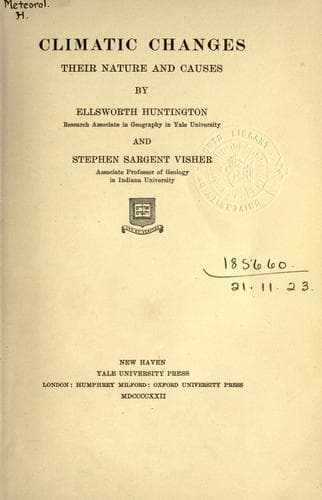
Climatic Changes: Their Nature and CausesHuntington, Ellsworth
Science
Climatic Changes: Their Nature and Causes
Huntington, Ellsworth
Climatic changes; Climatology; Paleoclimatology
Two conditions would especially help in this respect; first, changes in
nocturnal cooling, and second, changes in local convection. The presence
of carbon dioxide diminishes nocturnal cooling because it absorbs the
heat radiated by the earth, and re-radiates part of it back again. Hence
with increased carbon dioxide and with the consequent warmer nights
there would be less nocturnal condensation of water vapor to form dew
and frost. Local convection is influenced by carbon dioxide because this
gas lessens the temperature gradient. In general, the less the gradient,
that is, the less the contrast between the temperature at the surface
and higher up, the less convection takes place. This is illustrated by
the seasonal variation in convection. In summer, when the gradient is
steepest, convection reaches its maximum. It will be recalled that when
air rises it is cooled by expansion, and if it ascends far the moisture
is soon condensed and precipitated. Indeed, local convection is
considered by C. P. Day to be the chief agency which keeps the lower air
from being continually saturated with moisture. The presence of carbon
dioxide lessens convection because it increases the absorption of heat
in the zone above the level in which water vapor is abundant, thus
warming these higher layers. The lower air may not be warmed
correspondingly by an increase in carbon dioxide if Abbot and Fowle are
right in stating that near the earth's surface there is enough water
vapor to absorb practically all the wave lengths which carbon dioxide is
capable of absorbing. Hence carbon dioxide is chiefly effective at
heights to which the low temperature prevents water vapor from
ascending. Carbon dioxide is also effective in cold winters and in high
latitudes when even the lower air is too cold to contain much water
vapor. Moreover, carbon dioxide, by altering the amount of atmospheric
water vapor, exerts an indirect as well as a direct effect upon
temperature.
Public-domain text, read in full here on John Shaqi.
Reviews
Reviews
No reviews yet
Be the first to share your thoughts on this work.
Elsewhere in the archive
Join the Discussion
Join the discussion
Sign in to leave a comment or review.
Sign InorCreate an account