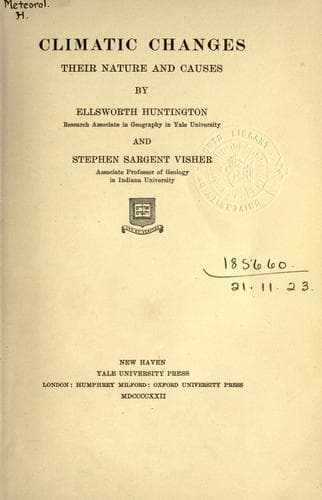
Climatic Changes: Their Nature and CausesHuntington, Ellsworth
Science
Climatic Changes: Their Nature and Causes
Huntington, Ellsworth
Climatic changes; Climatology; Paleoclimatology
Other effects of the increase in air pressure which we are here assuming
during at least the early part of geological times are corresponding
changes in barometric contrasts, in the strength of winds, and in the
mass of air carried by the winds along the earth's surface. The increase
in the mass of the air would reenforce the greater velocity of the winds
in their action as eroding and transporting agencies. Because of the
greater weight of the air, the winds would be capable of picking up more
dust and of carrying it farther and higher; while the increased
atmospheric friction would keep it aloft a longer time. The significance
of dust at high levels and its relation to solar radiation have already
been discussed in connection with volcanoes. It will be recalled that on
the average it lowers the surface temperature. At lower levels, since
dust absorbs heat quickly and gives it out quickly, its presence raises
the temperature of the air by day and lowers it by night. Hence an
increase in dustiness tends toward greater extremes.
From all these considerations it appears that if the atmosphere has
actually evolved according to the supposition which is here tentatively
entertained, the general tendency of the resultant climatic changes must
have been partly toward long geological oscillations and partly toward a
general though very slight increase in climatic severity and in the
contrasts between the zones. This seems to agree with the geological
record, although the fact that we are living in an age of relative
climatic severity may lead us astray.
The significant fact about the whole matter is that the three great
types of terrestrial agencies, namely, those of the earth's interior,
those of the oceans, and those of the air, all seem to have suffered
changes which lead to slow variations of climate. Many reversals have
doubtless taken place, and the geologic oscillations thus induced are
presumably of much greater importance than the progressive change, yet
so far as we can tell the purely terrestrial changes throughout the
hundreds of millions of years of geological time have tended toward
complexity and toward increased contrasts from continent to ocean, from
latitude to latitude, from season to season, and from day to night.
Public-domain text, read in full here on John Shaqi.
Reviews
Reviews
No reviews yet
Be the first to share your thoughts on this work.
Elsewhere in the archive
Join the Discussion
Join the discussion
Sign in to leave a comment or review.
Sign InorCreate an account