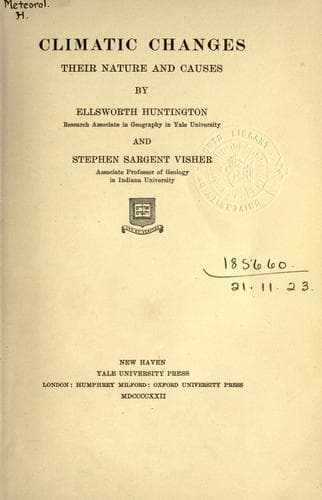
Climatic Changes: Their Nature and CausesHuntington, Ellsworth
Science
Climatic Changes: Their Nature and Causes
Huntington, Ellsworth
Climatic changes; Climatology; Paleoclimatology
Throughout geological history the slow and almost imperceptible
differentiation of the earth's surface has been one of the most
noteworthy of all changes. It has been opposed by the extraordinary
conservatism of the universe which causes the average temperature today
to be so like that of hundreds of millions of years ago that many types
of life are almost identical. Nevertheless, the differentiation has gone
on. Often, to be sure, it has presumably been completely masked by the
disturbances of the solar atmosphere which appear to have been the cause
of the sharper, shorter climatic pulsations. But regardless of cosmic
conservatism and of solar impulses toward change, the slow
differentiation of the earth's surface has apparently given to the world
of today much of the geographical complexity which is so stimulating a
factor in organic evolution. Such complexity--such diversity from place
to place--appears to be largely accounted for by purely terrestrial
causes. It may be regarded as the great terrestrial contribution to the
climatic environment which guides the development of life.
FOOTNOTES:
[Footnote 97: Encyclopaedia Britannica, 11th edition: article "Ocean."]
[Footnote 98: C. E. P. Brooks: The Meteorological Conditions of an Ice
sheet and Their Bearing on the Desiccation of the Globe; Quart. Jour.
Royal Meteorol. Soc., Vol. 40, 1914, pp. 53-70.]
[Footnote 99: Data of Geochemistry, Fourth Ed., 1920; Bull. No. 695, U.
S. Geol. Survey.]
[Footnote 100: Quoted by Schuchert in The Evolution of the Earth.]
[Footnote 101: Smithsonian Physical Tables, Sixth Revision, 1914, p.
142.]
[Footnote 102: Chamberlin, in a very suggestive article "On a possible
reversal of oceanic circulation" (Jour. of Geol., Vol. 14, pp. 363-373,
1906), discusses the probable climatic consequences of a reversal in the
direction of deep-sea circulation. It is not wholly beyond the bounds of
possibility that, in the course of ages the increasing drainage of salt
from the lands not only by nature but by man's activities in agriculture
and drainage, may ultimately cause such a reversal by increasing the
ocean's salinity until the more saline tropical portion is heavier than
the cooler but fresher subpolar waters. If that should happen,
Greenland, Antarctica, and the northern shores of America and Asia would
be warmed by the tropical heat which had been transferred poleward
beneath the surface of the ocean, without loss _en route_. Subpolar
regions, under such a condition of reversed deep-sea circulation, might
have a mild climate. Indeed, they might be among the world's most
favorable regions climatically.]
[Footnote 103: Encyclopaedia Britannica: article "Ocean."]
[Footnote 104: Chamberlin and Salisbury: Geology, Vol. II, pp. 1-132,
1906; and T. C. Chamberlin: The Origin of the Earth, 1916.]
[Footnote 105: Personal communication.]
[Footnote 106: R. T. Chamberlin: Gases in Rocks, Carnegie Inst. of
Wash., No. 106, 1908.]
Public-domain text, read in full here on John Shaqi.
Reviews
Reviews
No reviews yet
Be the first to share your thoughts on this work.
Elsewhere in the archive
Join the Discussion
Join the discussion
Sign in to leave a comment or review.
Sign InorCreate an account