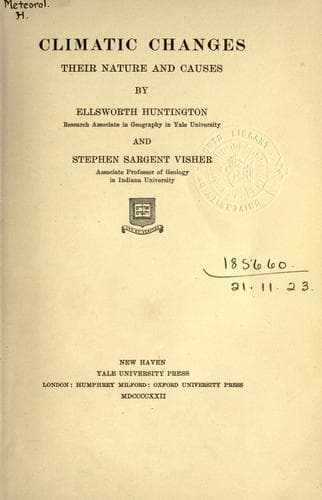
Climatic Changes: Their Nature and CausesHuntington, Ellsworth
Science
Climatic Changes: Their Nature and Causes
Huntington, Ellsworth
Climatic changes; Climatology; Paleoclimatology
[Footnote 107: J. Barrell: The Origin of the Earth, in Evolution of the
Earth and Its Inhabitants, 1918, p. 44, and more fully in an unpublished
manuscript.]
[Footnote 108: F. W. Clarke: Data of Geochemistry, Fourth Ed., 1920,
Bull. No. 695, U. S. Geol. Survey, p. 256.]
[Footnote 109: F. W. Clarke: _loc. cit._, pp. 27-34 et al.]
[Footnote C: Chas. E. St. John: Science Service Press Reports from the
Mt. Wilson Observatory, May, 1922.]
[Footnote 110: Abbot and Fowle: Annals Astrophysical Observatory;
Smiths. Inst., Vol. II, 1908, p. 163.
F. E. Fowle: Atmospheric Scattering of Light; Misc. Coll. Smiths. Inst.,
Vol. 69, 1918.]
[Footnote 111: Abbot and Fowle: _loc. cit._, p. 172.]
CHAPTER XIV
THE EFFECT OF OTHER BODIES ON THE SUN
If solar activity is really an important factor in causing climatic
changes, it behooves us to subject the sun to the same kind of inquiry
to which we have subjected the earth. We have inquired into the nature
of the changes through which the earth's crust, the oceans, and the
atmosphere have influenced the climate of geological times. It has not
been necessary, however, to study the origin of the earth, nor to trace
its earlier stages. Our study of the geological record begins only when
the earth had attained practically its present mass, essentially its
present shape, and a climate so similar to that of today that life as we
know it was possible. In other words, the earth had passed the stages of
infancy, childhood, youth, and early maturity, and had reached full
maturity. As it still seems to be indefinitely far from old age, we
infer that during geological times its relative changes have been no
greater than those which a man experiences between the ages of perhaps
twenty-five and forty.
Similar reasoning applies with equal or greater force to the sun.
Because of its vast size it presumably passes through its stages of
development much more slowly than the earth. In the first chapter of
this book we saw that the earth's relative uniformity of climate for
hundreds of millions of years seems to imply a similar uniformity in
solar activity. This accords with a recent tendency among astronomers
who are more and more recognizing that the stars and the solar system
possess an extraordinary degree of conservatism. Changes that once were
supposed to take place in thousands of years are now thought to have
required millions. Hence in this chapter we shall assume that throughout
geological times the condition of the sun has been almost as at present.
It may have been somewhat larger, or different in other ways, but it was
essentially a hot, gaseous body such as we see today and it gave out
essentially the same amount of energy. This assumption will affect the
general validity of what follows only if it departs widely from the
truth. With this assumption, then, let us inquire into the degree to
which the sun's atmosphere has probably been disturbed throughout
geological times.
Public-domain text, read in full here on John Shaqi.
Reviews
Reviews
No reviews yet
Be the first to share your thoughts on this work.
Elsewhere in the archive
Join the Discussion
Join the discussion
Sign in to leave a comment or review.
Sign InorCreate an account