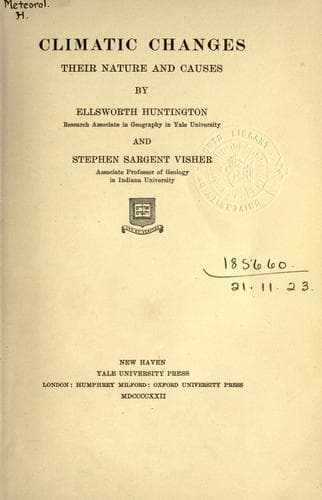
Climatic Changes: Their Nature and CausesHuntington, Ellsworth
Science
Climatic Changes: Their Nature and Causes
Huntington, Ellsworth
Climatic changes; Climatology; Paleoclimatology
In _Earth and Sun_, as already explained, a detailed study has led to
the conclusion that cyclonic storms are influenced by the electrical
action of the sun. Such action appears to be most intense in sunspots,
but apparently pertains also to other disturbed areas in the sun's
atmosphere. A study of sunspots suggests that their true periodicity is
almost if not exactly identical with that of the orbital revolution of
Jupiter, 11.8 years. Other investigations show numerous remarkable
coincidences between sunspots and the orbital revolution of the other
planets, including especially Saturn and Mercury. This seems to indicate
that there is some truth in the hypothesis that sunspots and other
related disturbances of the solar atmosphere owe their periodicity to
the varying effects of the planets as they approach and recede from the
sun in their eccentric orbits and as they combine or oppose their
effects according to their relative positions. This does not mean that
the energy of the solar disturbances is supposed to come from the
planets, but merely that their variations act like the turning of a
switch to determine when and how violently the internal forces of the
sun shall throw the solar atmosphere into commotion. This hypothesis is
by no means new, for in one form or another it has been advocated by
Wolfer, Birkeland, E. W. Brown, Schuster, Arctowski, and others.
The agency through which the planets influence the solar atmosphere is
not yet clear. The suggested agencies are the direct pull of
gravitation, the tidal effect of the planets, and an electro-magnetic
effect. In _Earth and Sun_ the conclusion is reached that the first two
are out of the question, a conclusion in which E. W. Brown acquiesces.
Unless some unknown cause is appealed to, this leaves an
electro-magnetic hypothesis as the only one which has a reasonable
foundation. Schuster inclines to this view. The conclusions set forth in
_Earth and Sun_ as to the electrical nature of the sun's influence on
the earth point somewhat in the same direction. Hence in this chapter we
shall inquire what would happen to the sun, and hence to the earth, on
their journey through space, if the solar atmosphere is actually subject
to disturbance by the electrical or other effects of other heavenly
bodies. It need hardly be pointed out that we are here venturing into
highly speculative ground, and that the verity or falsity of the
conclusions reached in this chapter has nothing to do with the validity
of the reasoning in previous chapters. Those chapters are based on the
assumption that terrestrial causes of climatic changes are supplemented
by solar disturbances which produce their effect partly through
variations in temperature but also through variations in the intensity
and paths of cyclonic storms. The present chapter seeks to shed some
light on the possible causes and sequence of solar disturbances.
Public-domain text, read in full here on John Shaqi.
Reviews
Reviews
No reviews yet
Be the first to share your thoughts on this work.
Elsewhere in the archive
Join the Discussion
Join the discussion
Sign in to leave a comment or review.
Sign InorCreate an account