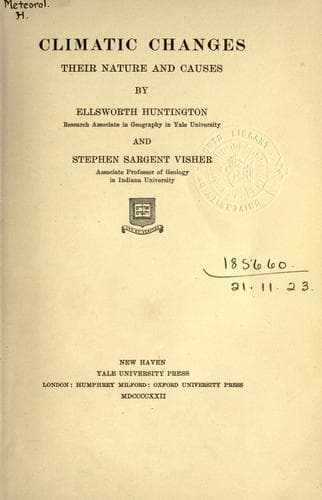
Climatic Changes: Their Nature and CausesHuntington, Ellsworth
Science
Climatic Changes: Their Nature and Causes
Huntington, Ellsworth
Climatic changes; Climatology; Paleoclimatology
Let us begin by scanning the available evidence as to solar disturbances
previous to the time when accurate sunspot records are available. Two
rather slender bits of evidence point to cycles of solar activity
lasting hundreds of years. One of these has already been discussed in
Chapter VI, where the climatic stress of the fourteenth century was
described. At that time sunspots are known to have been unusually
numerous, and there were great climatic extremes. Lakes overflowed in
Central Asia; storms, droughts, floods, and cold winters were unusually
severe in Europe; the Caspian Sea rose with great rapidity; the trees of
California grew with a vigor unknown for centuries; the most terrible of
recorded famines occurred in England and India; the Eskimos were
probably driven south by increasing snowiness in Greenland; and the
Mayas of Yucatan appear to have made their last weak attempt at a
revival of civilization under the stimulus of greater storminess and
less constant rainfall.
The second bit of evidence is found in recent exhaustive studies of
periodicities by Turner[112] and other astronomers. They have sought
every possible natural occurrence for which a numerical record is
available for a long period. The most valuable records appear to be
those of tree growth, Nile floods, Chinese earthquakes, and sunspots.
Turner reaches the conclusion that all four types of phenomena show the
same periodicity, namely, cycles with an average length of about 260 to
280 years. He suggests that if this is true, the cycles in tree growth
and in floods, both of which are climatic, are probably due to a
non-terrestrial cause. The fact that the sunspots show similar cycles
suggests that the sun's variations are the cause.
Public-domain text, read in full here on John Shaqi.
Reviews
Reviews
No reviews yet
Be the first to share your thoughts on this work.
Elsewhere in the archive
Join the Discussion
Join the discussion
Sign in to leave a comment or review.
Sign InorCreate an account