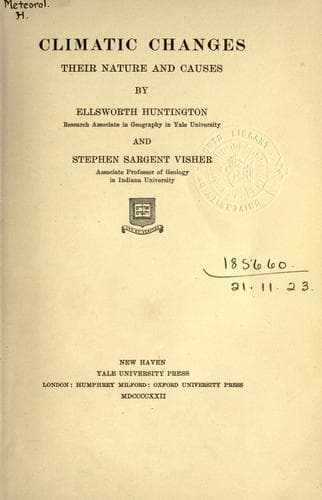
Climatic Changes: Their Nature and CausesHuntington, Ellsworth
Science
Climatic Changes: Their Nature and Causes
Huntington, Ellsworth
Climatic changes; Climatology; Paleoclimatology
These two bits of evidence are far too slight to form the foundation of
any theory as to changes in solar activity in the geological past.
Nevertheless it may be helpful to set forth certain possibilities as a
stimulus to further research. For example, it has been suggested that
meteoric bodies may have fallen into the sun and caused it suddenly to
flare up, as it were. This is not impossible, although it does not
appear to have taken place since men became advanced enough to make
careful observations. Moreover, the meteorites which now fall on the
earth are extremely small, the average size being computed as no larger
than a grain of wheat. The largest ever found on the earth's surface, at
Bacubirito in Mexico, weighs only about fifty tons, while within the
rocks the evidences of meteorites are extremely scanty and
insignificant. If meteorites had fallen into the sun often enough and of
sufficient size to cause glacial fluctuations and historic pulsations of
climate, it seems highly probable that the earth would show much more
evidence of having been similarly disturbed. And even if the sun should
be bombarded by large meteors the result would probably not be sudden
cold periods, which are the most notable phenomena of the earth's
climatic history, but sudden warm periods followed by slow cooling.
Nevertheless, the disturbance of the sun by collision with meteoric
matter can by no means be excluded as a possible cause of climatic
variations.
Allied to the preceding hypothesis is Shapley's[113] nebular hypothesis.
At frequent intervals, averaging about once a year during the last
thirty years, astronomers have discovered what are known as novae. These
are stars which were previously faint or even invisible, but which flash
suddenly into brilliancy. Often their light-giving power rises seven or
eight magnitudes--a thousand-fold. In addition to the spectacular novae
there are numerous irregular variables whose brilliancy changes in every
ratio from a few per cent up to several magnitudes. Most of them are
located in the vicinity of nebulae, as is also the case with novae. This,
as well as other facts, makes it probable that all these stars are
"friction variables," as Shapley calls them. Apparently as they pass
through the nebulae they come in contact with its highly diffuse matter
and thereby become bright much as the earth would become bright if its
atmosphere were filled with millions of almost infinitesimally small
meteorites. A star may also lose brilliancy if nebulous matter
intervenes between it and the observer. If our sun has been subjected to
any of these changes some sort of climatic effect must have been
produced.
In a personal communication Shapley amplifies the nebular climatic
hypothesis as follows:
Public-domain text, read in full here on John Shaqi.
Reviews
Reviews
No reviews yet
Be the first to share your thoughts on this work.
Elsewhere in the archive
Join the Discussion
Join the discussion
Sign in to leave a comment or review.
Sign InorCreate an account