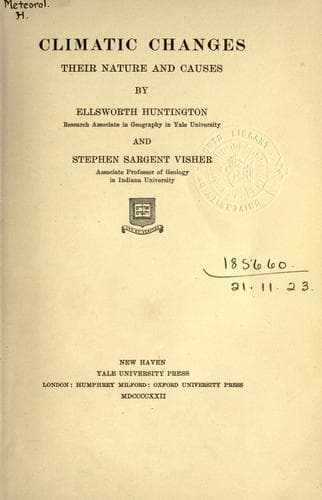
Climatic Changes: Their Nature and CausesHuntington, Ellsworth
Science
Climatic Changes: Their Nature and Causes
Huntington, Ellsworth
Climatic changes; Climatology; Paleoclimatology
Within 700 light years of the sun in many directions (Taurus,
Cygnus, Ophiuchus, Scorpio) are great diffuse clouds of nebulosity,
some bright, most of them dark. The probability that stars moving in
the general region of such clouds will encounter this material is
very high, for the clouds fill enormous volumes of space,--e.g.,
probably more than a hundred thousand cubic light years in the Orion
region, and are presumably composed of rarefied gases or of dust
particles. Probably throughout all our part of space such nebulosity
exists (it is all around us, we are sure), but only in certain
regions is it dense enough to affect conspicuously the stars
involved in it. If a star moving at high velocity should collide
with a dense part of such a nebulous cloud, we should probably have
a typical nova. If the relative velocity of nebulous material and
star were low or moderate, or if the material were rare, we should
not expect a conspicuous effect on the star's light.
In the nebulous region of Orion, which is probably of unusually high
density, there are about 100 known stars, varying between 20% and
80% of their total light--all of them irregularly--some slowly, some
suddenly. Apparently they are "friction variables." Some of the
variables suddenly lose 40% of their light as if blanketed by
nebulous matter. In the Trifid Nebula there are variables like those
of Orion, in Messier 8 also, and probably many of the 100 or so
around the Rho Ophiuchi region belong to this kind.
I believe that our sun could not have been a typical nova, at least
not since the Archeozoic, that is for perhaps a billion years. I
believe we have in geological climates final proof of this, because
an increase in the amount of solar radiation by 1000 times as in the
typical nova, would certainly punctuate emphatically the life cycle
on the earth, even if the cause of the nova would not at the same
time eliminate the smaller planets. But the sun may have been one of
these miniature novae or friction variables; and I believe it very
probable that its wanderings through this part of space could not
long leave its mean temperature unaffected to the amount of a few
per cent.
One reason we have not had this proposal insisted upon before is
that the data back of it are mostly new--the Orion variables have
been only recently discovered and studied, the distribution and
content of the dark nebulae are hardly as yet generally known.
Public-domain text, read in full here on John Shaqi.
Reviews
Reviews
No reviews yet
Be the first to share your thoughts on this work.
Elsewhere in the archive
Join the Discussion
Join the discussion
Sign in to leave a comment or review.
Sign InorCreate an account