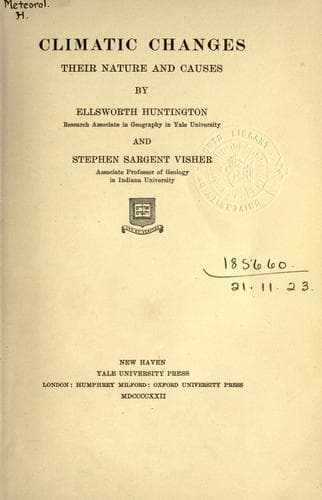
Climatic Changes: Their Nature and CausesHuntington, Ellsworth
Science
Climatic Changes: Their Nature and Causes
Huntington, Ellsworth
Climatic changes; Climatology; Paleoclimatology
This interesting hypothesis cannot be hastily dismissed. If the sun
should pass through a nebula it seems inevitable that there would be at
least slight climatic effects and perhaps catastrophic effects through
the action of the gaseous matter not only on the sun but on the earth's
own atmosphere. As an explanation of the general climatic conditions of
the past, however, Shapley points out that the hypothesis has the
objection of being vague, and that nebulosity should not be regarded as
more than "a possible factor." One of the chief difficulties seems to be
the enormously wide distribution of as yet undiscovered nebulous matter
which must be assumed if any large share of the earth's repeated
climatic changes is to be ascribed to such matter. If such matter is
actually abundant in space, it is hard to see how any but the nearest
stars would be visible. Another objection is that there is no known
nebulosity near at hand with which to connect the climatic vicissitudes
of the last glacial period. Moreover, the known nebulae are so much less
numerous than stars that the chances that the sun will encounter one of
them are extremely slight. This, however, is not an objection, for
Shapley points out that during geological times the sun can never have
varied as much as do the novae, or even as most of the friction
variables. Thus the hypothesis stands as one that is worth
investigating, but that cannot be finally rejected or accepted until it
is made more definite and until more information is available.
Another suggested cause of solar variations is the relatively sudden
contraction of the sun such as that which sometimes occurs on the earth
when continents are uplifted and mountains upheaved. It seems improbable
that this could have occurred in a gaseous body like the sun. Lacking,
as it does, any solid crust which resists a change of form, the sun
probably shrinks steadily. Hence any climatic effects thus produced must
be extremely gradual and must tend steadily in one direction for
millions of years.
Public-domain text, read in full here on John Shaqi.
Reviews
Reviews
No reviews yet
Be the first to share your thoughts on this work.
Elsewhere in the archive
Join the Discussion
Join the discussion
Sign in to leave a comment or review.
Sign InorCreate an account