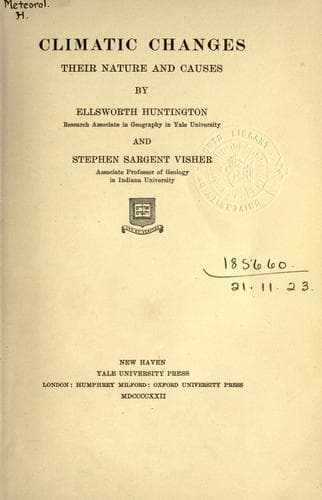
Climatic Changes: Their Nature and CausesHuntington, Ellsworth
Science
Climatic Changes: Their Nature and Causes
Huntington, Ellsworth
Climatic changes; Climatology; Paleoclimatology
Still another suggestion is that the tidal action of the stars and other
bodies which may chance to approach the sun's path may cause
disturbances of the solar atmosphere. The vast kaleidoscope of space is
never quiet. The sun, the stars, and all the other heavenly bodies are
moving, often with enormous speed. Hence the effect of gravitation upon
the sun must vary constantly and irregularly, as befits the geological
requirements. In the case of the planets, however, the tidal effect does
not seem competent to produce the movements of the solar atmosphere
which appear to be concerned in the inception of sunspots. Moreover,
there is only the most remote probability that a star and the sun will
approach near enough to one another to produce a pronounced
gravitational disturbance in the solar atmosphere. For instance, if it
be assumed that changes in Jupiter's tidal effect on the sun are the
main factor in regulating the present difference between sunspot maxima
and sunspot minima, the chances that a star or some non-luminous body of
similar mass will approach near enough to stimulate solar activity and
thereby bring on glaciation are only one in twelve billion years, as
will be explained below. This seems to make a gravitational hypothesis
impossible.
Another possible cause of solar disturbances is that the stars in their
flight through space may exert an electrical influence which upsets the
equilibrium of the solar atmosphere. At first thought this seems even
more impossible than a gravitational effect. Electrostatic effects,
however, differ greatly from those of tides. They vary as the diameter
of a body instead of as its mass; their differentials also vary
inversely as the square of the distance instead of as the cube.
Electrostatic effects also increase as the fourth power of the
temperature or at least would do so if they followed the law of black
bodies; they are stimulated by the approach of one body to another; and
they are cumulative, for if ions arrive from space they must accumulate
until the body to which they have come begins to discharge them. Hence,
on the basis of assumptions such as those used in the preceding
paragraph, the chances of an electrical disturbance of the solar
atmosphere sufficient to cause glaciation on the earth may be as high as
one in twenty or thirty million years. This seems to put an electrical
hypothesis within the bounds of possibility. Further than that we cannot
now go. There may be other hypotheses which fit the facts much better,
but none seems yet to have been suggested.
Public-domain text, read in full here on John Shaqi.
Reviews
Reviews
No reviews yet
Be the first to share your thoughts on this work.
Elsewhere in the archive
Join the Discussion
Join the discussion
Sign in to leave a comment or review.
Sign InorCreate an account