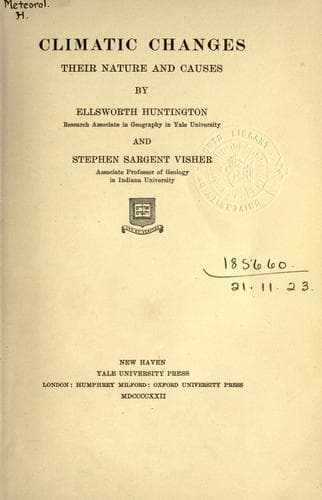
Climatic Changes: Their Nature and CausesHuntington, Ellsworth
Science
Climatic Changes: Their Nature and Causes
Huntington, Ellsworth
Climatic changes; Climatology; Paleoclimatology
In the rest of this chapter the tidal and electrical hypotheses of
stellar action on the sun will be taken up in detail. The tidal
hypothesis is considered because in discussions of the effect of the
planets it has hitherto held almost the entire field. The electrical
hypothesis will be considered because it appears to be the best yet
suggested, although it still seems doubtful whether electrical effects
can be of appreciable importance over such vast distances as are
inevitably involved. The discussion of both hypotheses will necessarily
be somewhat technical, and will appeal to the astronomer more than to
the layman. It does not form a necessary part of this book, for it has
no bearing on our main thesis of the effect of the sun on the earth. It
is given here because ultimately the question of changes in solar
activity during geological times must be faced.
In the astronomical portion of the following discussion we shall follow
Jeans[114] in his admirable attempt at a mathematical analysis of the
motions of the universe. Jeans divides the heavenly bodies into five
main types. (1) Spiral nebulae, which are thought by some astronomers to
be systems like our own in the making, and by others to be independent
universes lying at vast distances beyond the limits of our Galactic
universe, as it is called from the Galaxy or Milky Way. (2) Nebulae of a
smaller type, called planetary. These lie within the Galactic portion of
the universe and seem to be early stages of what may some day be stars
or solar systems. (3) Binary or multiple stars, which are
extraordinarily numerous. In some parts of the heavens they form 50 or
even 60 per cent of the stars and in the galaxy as a whole they seem to
form "fully one third." (4) Star clusters. These consist of about a
hundred groups of stars in each of which the stars move together in the
same direction with approximately the same velocity. These, like the
spiral nebulae, are thought by some astronomers to lie outside the limits
of the galaxy, but this is far from certain. (5) The solar system.
According to Jeans this seems to be unique. It does not fit into the
general mathematical theory by which he explains spiral nebulae,
planetary nebulae, binary stars, and star clusters. It seems to demand a
special explanation, such as is furnished by tidal disruption due to the
passage of the sun close to another star.
Public-domain text, read in full here on John Shaqi.
Reviews
Reviews
No reviews yet
Be the first to share your thoughts on this work.
Elsewhere in the archive
Join the Discussion
Join the discussion
Sign in to leave a comment or review.
Sign InorCreate an account