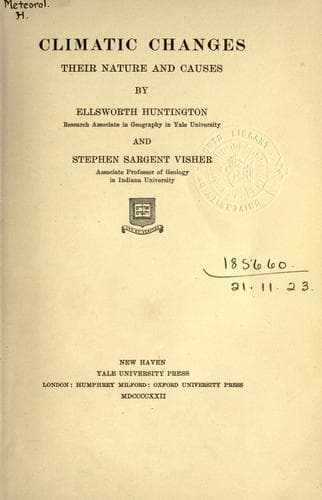
Climatic Changes: Their Nature and CausesHuntington, Ellsworth
Science
Climatic Changes: Their Nature and Causes
Huntington, Ellsworth
Climatic changes; Climatology; Paleoclimatology
The part of Jeans' work which specially concerns us is his study of the
probability that some other star will approach the sun closely enough to
have an appreciable gravitative or electrical effect, and thus cause
disturbances in the solar atmosphere. Of course both the star and the
sun are moving, but to avoid circumlocution we shall speak of such
mutual approaches simply as approaches of the sun. For our present
purpose the most fundamental fact may be summed up in a quotation from
Jeans in which he says that most stars "show evidence of having
experienced considerable disturbance by other systems; there is no
reason why our solar system should be expected to have escaped the
common fate." Jeans gives a careful calculation from which it is
possible to derive some idea of the probability of any given degree of
approach of the sun and some other star. Of course all such calculations
must be based on certain assumptions. The assumptions made by Jeans are
such as to make the probability of close approaches as great as
possible. For example, he allows only 560 million years for the entire
evolution of the sun, whereas some astronomers and geologists would put
the figure ten or more times as high. Nevertheless, Jeans' assumptions
at least show the order of magnitude which we may expect on the basis of
reasonable astronomical conclusions.
According to the planetary hypothesis of sunspots, the difference in the
effect of Jupiter when it is nearest and farthest from the sun is the
main factor in starting the sunspot cycle and hence the corresponding
terrestrial cycle. The climatic difference between sunspot maxima and
minima, as measured by temperature, apparently amounts to at least a
twentieth and perhaps a tenth of the difference between the climate of
the last glacial epoch and the present. We may suppose, then, that a
body which introduced a gravitative or electrical factor twenty times as
great as the difference in Jupiter's effect at its maximum and minimum
distances from the sun would cause a glacial epoch if the effect lasted
long enough. Of course the other planets combine their effects with that
of Jupiter, but for the sake of simplicity we will leave the others out
of account. The difference between Jupiter's maximum and minimum tidal
effect on the sun amounts to 29 per cent of the planet's average effect.
The corresponding difference, according to the electrical hypothesis, is
about 19 per cent, for electrostatic action varies as the square of the
distance instead of as the cube. Let us assume that a body exerting four
times Jupiter's present tidal effect and placed at the average distance
of Jupiter from the sun would disturb the sun's atmosphere twenty times
as much as the present difference between sunspot maxima and minima, and
thus, perhaps, cause a glacial period on the earth.
Public-domain text, read in full here on John Shaqi.
Reviews
Reviews
No reviews yet
Be the first to share your thoughts on this work.
Elsewhere in the archive
Join the Discussion
Join the discussion
Sign in to leave a comment or review.
Sign InorCreate an account