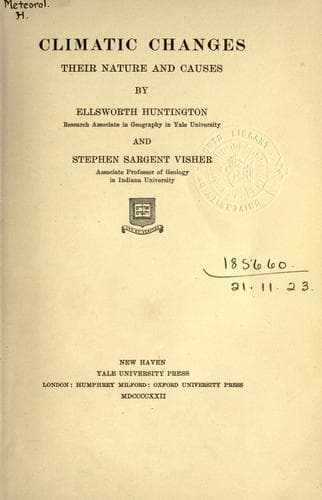
Climatic Changes: Their Nature and CausesHuntington, Ellsworth
Science
Climatic Changes: Their Nature and Causes
Huntington, Ellsworth
Climatic changes; Climatology; Paleoclimatology
Again, although the earth's atmosphere has probably changed far less
during geological times than was formerly supposed, its composition has
doubtless varied. The total volume of nitrogen has probably increased,
for that gas is so inert that when it once becomes a part of the air it
is almost sure to stay there. On the other hand, the proportions of
oxygen, carbon dioxide, and water vapor must have fluctuated. Oxygen is
taken out constantly by animals and by all the processes of rock
weathering, but on the other hand the supply is increased when plants
break up new carbon dioxide derived from volcanoes. As for the carbon
dioxide, it appears probable that in spite of the increased supply
furnished by volcanoes the great amounts of carbon which have gradually
been locked up in coal and limestone have appreciably depleted the
atmosphere. Water vapor also may be less abundant now than in the past,
for the presence of carbon dioxide raises the temperature a little and
thereby enables the air to hold more moisture. When the area of the
oceans has diminished, and this has recurred very often, this likewise
would tend to reduce the water vapor. Moreover, even a very slight
diminution in the amount of heat given off by the earth, or a decrease
in evaporation because of higher salinity in the oceans, would tend in
the same direction. Now carbon dioxide and water vapor both have a
strong blanketing effect whereby heat is prevented from leaving the
earth. Therefore, the probable reduction in the carbon dioxide and water
vapor of the earth's atmosphere has apparently tended to reduce the
climatic monotony and create diversity and complexity. Hence, in spite
of many reversals, the general tendency of changes, not only in the
earth's interior and in the oceans, but also in the atmosphere, appears
to be a secular progression from a relatively monotonous climate in
which the evolution of higher organic forms would scarcely be rapid to
an extremely diverse and complex climate highly favorable to progressive
evolution. The importance of these purely terrestrial agencies must not
be lost sight of when we come to discuss other agencies outside the
earth.
Public-domain text, read in full here on John Shaqi.
Reviews
Reviews
No reviews yet
Be the first to share your thoughts on this work.
Join the Discussion
Join the discussion
Sign in to leave a comment or review.
Sign InorCreate an account