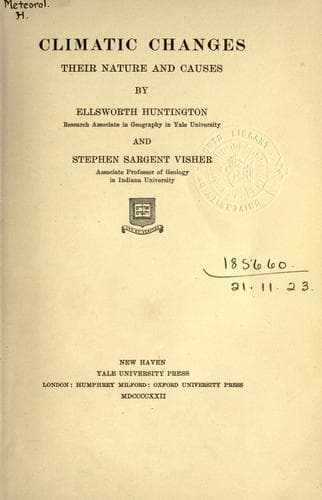
Climatic Changes: Their Nature and CausesHuntington, Ellsworth
Science
Climatic Changes: Their Nature and Causes
Huntington, Ellsworth
Climatic changes; Climatology; Paleoclimatology
much greater degree in the past, or be destined to do so in the future.
Thus an electrical hypothesis of solar disturbances seems to indicate
that the position of the sun in respect to other stars may be a factor
of great importance in determining the earth's climate.
FOOTNOTES:
[Footnote 112: H. H. Turner: On a Long Period in Chinese Earthquake
Records; Mon. Not. Royal Astron. Soc., Vol. 79, 1919, pp. 531-539; Vol.
80, 1920, pp. 617-619; Long Period Terms in the Growth of Trees; _idem_,
pp.793-808.]
[Footnote 113: Harlow Shapley: Note on a Possible Factor in Geologic
Climates; Jour. Geol., Vol. 29, No. 4, May, 1921; Novae and Variable
Stars, Pub. Astron. Soc. Pac., No. 194, Aug., 1921.]
[Footnote 114: J. H. Jeans: Problems of Cosmogony and Stellar Dynamics,
Cambridge, 1919.]
[Footnote 115: This fact is so important and at the same time so
surprising to the layman, that a quotation from The Electron Theory of
Matter by O. W. Richardson, 1914, pp. 326 and 334 is here added.
"It is a very familiar fact that when material bodies are heated they
emit electromagnetic radiations, in the form of thermal, luminous, and
actinic rays, in appreciable quantities. Such an effect is a natural
consequence of the electron and kinetic theories of matter. On the
kinetic theory, temperature is a measure of the violence of the motion
of the ultimate particles; and we have seen that on the electron theory,
electromagnetic radiation is a consequence of their acceleration. The
calculation of this emission from the standpoint of the electron theory
alone is a very complex problem which takes us deeply into the structure
of matter and which has probably not yet been satisfactorily resolved.
Fortunately, we can find out a great deal about these phenomena by the
application of general principles like the conservation of energy and
the second law of thermodynamics without considering special assumptions
about the ultimate constitution of matter. It is to be borne in mind
that the emission under consideration occurs at all temperatures
although it is more marked the higher the temperature.... The energy per
unit volume, _in vacuo_, of the radiation in equilibrium in an enclosure
at the absolute temperature, T, is equal to a universal constant, A,
multiplied by the fourth power of the absolute temperature. Since the
intensity of the radiation is equal to the energy per unit volume
multiplied by the velocity of light, it follows that the former must
also be proportional to the fourth power of the absolute temperature.
Moreover, if E is the total emission from unit area of a perfectly black
body, we see from p. 330 that E=A'T^{4}, where A' is a new universal
constant. This result is usually known as Stefan's Law. It was suggested
by Stefan in the inaccurate form that the total radiant energy of
emission from bodies varies as the fourth power of the absolute
temperature, as a generalization from the results of experiments. The
Public-domain text, read in full here on John Shaqi.
Reviews
Reviews
No reviews yet
Be the first to share your thoughts on this work.
Elsewhere in the archive
Join the Discussion
Join the discussion
Sign in to leave a comment or review.
Sign InorCreate an account