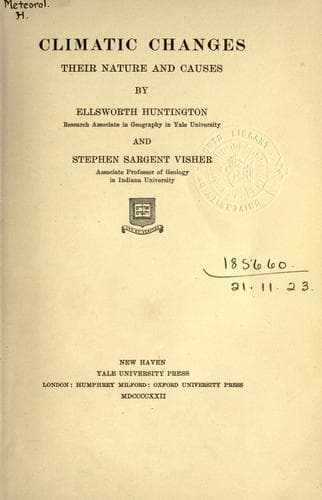
Climatic Changes: Their Nature and CausesHuntington, Ellsworth
Science
Climatic Changes: Their Nature and Causes
Huntington, Ellsworth
Climatic changes; Climatology; Paleoclimatology
credit for showing that it is a consequence of the existence of
radiation pressure combined with the principles of thermodynamics is due
to Bartoli and Boltzmann."]
[Footnote 116: Quoted by Moulton in his Introduction to Astronomy.]
[Footnote 117: Introduction to Astronomy.]
[Footnote 118: The term billions, here and elsewhere, is used in the
American sense, 10^{9}.]
[Footnote 119: The assumed number of stars here is ten times as great as
in the other parts of this line.]
CHAPTER XV
THE SUN'S JOURNEY THROUGH SPACE
Having gained some idea of the nature of the electrical hypothesis of
solar disturbances and of the possible effect of other bodies upon the
sun's atmosphere, let us now compare the astronomical data with those of
geology. Let us take up five chief points for which the geologist
demands an explanation, and which any hypothesis must meet if it is to
be permanently accepted. These are (1) the irregular intervals at which
glacial periods occur; (2) the division of glacial periods into epochs
separated sometimes by hundreds of thousands of years; (3) the length of
glacial periods and epochs; (4) the occurrence of glacial stages and
historic pulsations in the form of small climatic waves superposed upon
the larger waves of glacial epochs; (5) the occurrence of climatic
conditions much milder than those of today, not only in the middle
portion of the great geological eras, but even in some of the recent
inter-glacial epochs.
1. The irregular duration of the interval from one glacial epoch to
another corresponds with the irregular distribution of the stars. If
glaciation is indirectly due to stellar influences, the epochs might
fall close together, or might be far apart. If the average interval were
ten million years, one interval might be thirty million or more and the
next only one or two hundred thousand. According to Schuchert, the known
periods of glacial or semi-glacial climate have been approximately as
follows:
LIST OF GLACIAL PERIODS
1. Archeozoic.
(1/4 of geological time or perhaps much more)
No known glacial periods.
2. Proterozoic.
(1/4 of geological time)
a. Oldest known glacial period near base of Proterozoic in
Canada. Evidence widely distributed.
b. Indian glacial period; time unknown.
c. African glacial period; time unknown.
d. Glaciation near end of Proterozoic in Australia, Norway,
and China.
3. Paleozoic.
(1/4 of geological time)
a. Late Ordovician(?). Local in Arctic Norway.
b. Silurian. Local in Alaska.
c. Early Devonian. Local in South Africa.
d. Early Permian. World-wide and very severe.
4. Mesozoic and Cenozoic.
(1/4 of geological time)
a-b. None definitely determined during Mesozoic, although
there appears to have been periods of cooling (a) in the
late Triassic, and (b) in the late Cretacic, with at least
local glaciation in early Eocene.
Public-domain text, read in full here on John Shaqi.
Reviews
Reviews
No reviews yet
Be the first to share your thoughts on this work.
Elsewhere in the archive
Join the Discussion
Join the discussion
Sign in to leave a comment or review.
Sign InorCreate an account