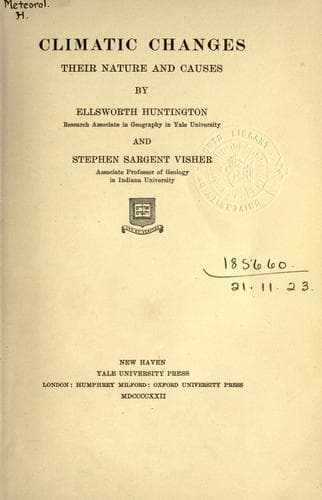
Climatic Changes: Their Nature and CausesHuntington, Ellsworth
Science
Climatic Changes: Their Nature and Causes
Huntington, Ellsworth
Climatic changes; Climatology; Paleoclimatology
c. Severe glacial period during Pleistocene.
This table suggests an interesting inquiry. During the last few decades
there has been great interest in ancient glaciation and geologists have
carefully examined rocks of all ages for signs of glacial deposits. In
spite of the large parts of the earth which are covered with deposits
belonging to the Mesozoic and Cenozoic, which form the last quarter of
geological time, the only signs of actual glaciation are those of the
great Pleistocene period and a few local occurrences at the end of the
Mesozoic or beginning of the Cenozoic. Late in the Triassic and early in
the Jurassic, the climate appears to have been rigorous, although no
tillites have been found to demonstrate glaciation. In the preceding
quarter, that is, the Paleozoic, the Permian glaciation was more severe
than that of the Pleistocene, and the Devonian than that of the Eocene,
while the Ordovician evidences of low temperature are stronger than
those at the end of the Triassic. In view of the fact that rocks of
Paleozoic age cover much smaller areas than do those of later age, the
three Paleozoic glaciations seem to indicate a relative frequency of
glaciation. Going back to the Proterozoic, it is astonishing to find
that evidence of two highly developed glacial periods, and possibly
four, has been discovered. Since the Indian and the African glaciations
of Proterozoic times are as yet undated, we cannot be sure that they are
not of the same date as the others. Nevertheless, even two is a
surprising number, for not only are most Proterozoic rocks so
metamorphosed that possible evidences of glacial origin are destroyed,
but rocks of that age occupy far smaller areas than either those of
Paleozoic or, still more, Mesozoic and Cenozoic age. Thus the record of
the last three-quarters of geological time suggests that if rocks of all
ages were as abundant and as easily studied as those of the later
periods, the frequency of glacial periods would be found to increase as
one goes backward toward the beginnings of the earth's history. This is
interesting, for Jeans holds that the chances that the stars would
approach one another were probably greater in the past than at present.
This conclusion is based on the assumption that our universe is like the
spiral nebulae in which the orbits of the various members are nearly
circular during the younger stages. Jeans considers it certain that in
such cases the orbits will gradually become larger and more elliptical
because of the attraction of one body for another. Thus as time goes on
the stars will be more widely distributed and the chances of approach
will diminish. If this is correct, the agreement between astronomical
theory and geological conclusions suggests that the two are at least not
in opposition.
Public-domain text, read in full here on John Shaqi.
Reviews
Reviews
No reviews yet
Be the first to share your thoughts on this work.
Elsewhere in the archive
Join the Discussion
Join the discussion
Sign in to leave a comment or review.
Sign InorCreate an account