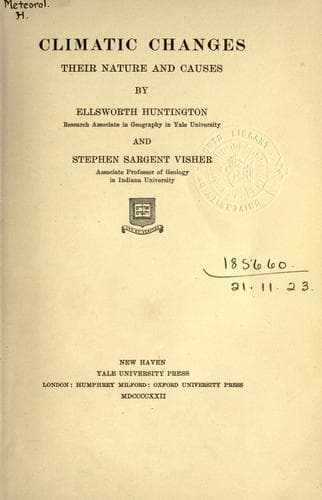
Climatic Changes: Their Nature and CausesHuntington, Ellsworth
Science
Climatic Changes: Their Nature and Causes
Huntington, Ellsworth
Climatic changes; Climatology; Paleoclimatology
The first quarter of geological time as well as the last three must be
considered in this connection. During the Archeozoic, no evidence of
glaciation has yet been discovered. This suggests that the geological
facts disprove the astronomical theory. But our knowledge of early
geological times is extremely limited, so limited that lack of evidence
of glaciation in the Archeozoic may have no significance. Archeozoic
rocks have been studied minutely over a very small percentage of the
earth's land surface. Moreover, they are highly metamorphosed so that,
even if glacial tills existed, it would be hard to recognize them.
Third, according to both the nebular and the planetesimal hypotheses, it
seems possible that during the earliest stages of geological history the
earth's interior was somewhat warmer than now, and the surface may have
been warmed more than at present by conduction, by lava flows, and by
the fall of meteorites. If the earth during the Archeozoic period
emitted enough heat to raise its surface temperature a few degrees, the
heat would not prevent the development of low forms of life but might
effectively prevent all glaciation. This does not mean that it would
prevent changes of climate, but merely changes so extreme that their
record would be preserved by means of ice. It will be most interesting
to see whether future investigations in geology and astronomy indicate
either a semi-uniform distribution of glacial periods throughout the
past, or a more or less regular decrease in frequency from early times
down to the present.
2. The Pleistocene glacial period was divided into at least four epochs,
while in the Permian at least one inter-glacial epoch seems certain, and
in some places the alternation between glacial and non-glacial beds
suggests no less than nine. In the other glaciations the evidence is not
yet clear. The question of periodicity is so important that it
overthrows most glacial hypotheses. Indeed, had their authors known the
facts as established in recent years, most of the hypotheses would never
have been advanced. The carbon dioxide hypothesis is the only one which
was framed with geologically rapid climatic alternations in mind. It
certainly explains the facts of periodicity better than does any of its
predecessors, but even so it does not account for the intimate way in
which variations of all degrees from those of the weather up to glacial
epochs seem to grade into one another.
Public-domain text, read in full here on John Shaqi.
Reviews
Reviews
No reviews yet
Be the first to share your thoughts on this work.
Elsewhere in the archive
Join the Discussion
Join the discussion
Sign in to leave a comment or review.
Sign InorCreate an account