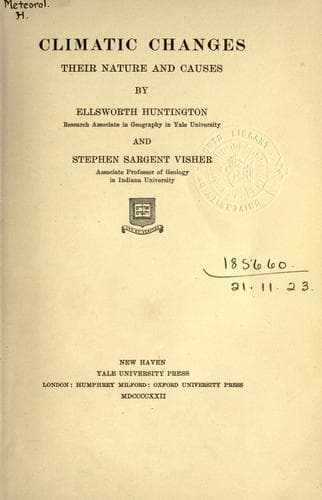
Climatic Changes: Their Nature and CausesHuntington, Ellsworth
Science
Climatic Changes: Their Nature and Causes
Huntington, Ellsworth
Climatic changes; Climatology; Paleoclimatology
According to our stellar hypothesis, occasional groups of glacial epochs
would be expected to occur close together and to form long glacial
periods. This is because many of the stars belong to groups or clusters
in which the stars move in parallel paths. A good example is the cluster
in the Hyades, where Boss has studied thirty-nine stars with special
care.[120] The stars are grouped about a center about 130 light years
from the sun. The stars themselves are scattered over an area about
thirty light years in diameter. They average about the same distance
apart as do those near the sun, but toward the center of the group they
are somewhat closer together. The whole thirty-nine sweep forward in
essentially parallel paths. Boss estimates that 800,000 years ago the
cluster was only half as far from the sun as at present, but probably
that was as near as it has been during recent geological times. All of
the thirty-nine stars of this cluster, as Moulton[121] puts it, "are
much greater in light-giving power than the sun. The luminosities of
even the five smallest are from five to ten times that of the sun, while
the largest are one hundred times greater in light-giving power than our
own luminary. Their masses are probably much greater than that of the
sun." If the sun were to pass through such a cluster, first one star and
then another might come so near as to cause a profound disturbance in
the sun's atmosphere.
3. Another important point upon which a glacial hypothesis may come to
grief is the length of the periods or rather of the epochs which compose
the periods. During the last or Pleistocene glacial period the evidence
in America and Europe indicates that the inter-glacial epochs varied in
length and that the later ones were shorter than the earlier. Chamberlin
and Salisbury, from a comparison of various authorities, estimate that
the intervals from one glacial epoch to another form a declining series,
which may be roughly expressed as follows: 16-8-4-2-1, where unity is
the interval from the climax of the late Wisconsin, or last glacial
epoch, to the present. Most authorities estimate the culmination of the
late Wisconsin glaciation as twenty or thirty thousand years ago. Penck
estimates the length of the last inter-glacial period as 60,000 years
and the preceding one as 240,000.[122] R. T. Chamberlin, as already
stated, finds that the consensus of opinion is that inter-glacial epochs
have averaged five times as long as glacial epochs. The actual duration
of the various glaciations probably did not vary in so great a ratio as
did the intervals from one glaciation to another. The main point,
however, is the irregularity of the various periods.
Public-domain text, read in full here on John Shaqi.
Reviews
Reviews
No reviews yet
Be the first to share your thoughts on this work.
Elsewhere in the archive
Join the Discussion
Join the discussion
Sign in to leave a comment or review.
Sign InorCreate an account