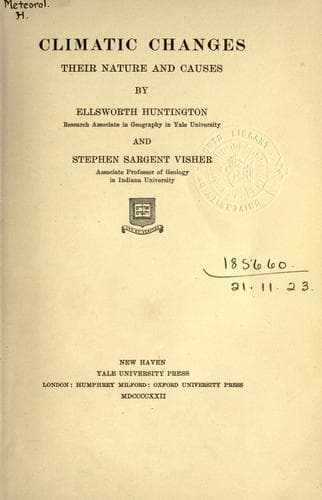
Climatic Changes: Their Nature and CausesHuntington, Ellsworth
Science
Climatic Changes: Their Nature and Causes
Huntington, Ellsworth
Climatic changes; Climatology; Paleoclimatology
The relation of the stellar electrical hypothesis to the length of
glacial epochs may be estimated from column C, in Table 5. There we see
that the distances at which a star might possibly disturb the sun enough
to cause glaciation range all the way from 120 billion miles in the case
of a small star like the sun, to 3200 billion in the case of Betelgeuse,
while for double stars the figure may rise a hundred times higher. From
this we can calculate how long it would take a star to pass from a point
where its influence would first amount to a quarter of the assumed
maximum to a similar point on the other side of the sun. In making these
calculations we will assume that the relative rate at which the star and
the sun approach each other is about twenty-two miles per second, or 700
million miles per year, which is the average rate of motion of all the
known stars. According to the distances in Table 5 this gives a range
from about 500 years up to about 10,000, which might rise to a million
in the case of double stars. Of course the time might be relatively
short if the sun and a rapidly moving star were approaching one another
almost directly, or extremely long if the sun and the star were moving
in almost the same direction and at somewhat similar rates,--a condition
more common than the other. Here, as in so many other cases, the
essential point is that the figures which we thus obtain seem to be of
the right order of magnitude.
4. Post-glacial climatic stages are so well known that in Europe they
have definite names. Their sequence has already been discussed in
Chapter XII. Fossils found in the peat bogs of Denmark and Scandinavia,
for example, prove that since the final disappearance of the continental
ice cap at the close of the Wisconsin there has been at least one period
when the climate of Europe was distinctly milder than now. Directly
overlying the sheets of glacial drift laid down by the ice there is a
flora corresponding to that of the present tundras. Next come remains of
a forest vegetation dominated by birches and poplars, showing that the
climate was growing a little warmer. Third, there follow evidences of a
still more favorable climate in the form of a forest dominated by pines;
fourth, one where oak predominates; and fifth, a flora similar to that
of the Black Forest of Germany, indicating that in Scandinavia the
temperature was then decidedly higher than today. This fifth flora has
retreated southward once more, having been driven back to its present
latitude by a slight recurrence of a cool stormy climate.[123] In
central Asia evidence of post-glacial stages is found not only in five
distinct moraines but in a corresponding series of elevated strands
surrounding salt lakes and of river terraces in non-glaciated arid
regions.[124]
Public-domain text, read in full here on John Shaqi.
Reviews
Reviews
No reviews yet
Be the first to share your thoughts on this work.
Elsewhere in the archive
Join the Discussion
Join the discussion
Sign in to leave a comment or review.
Sign InorCreate an account