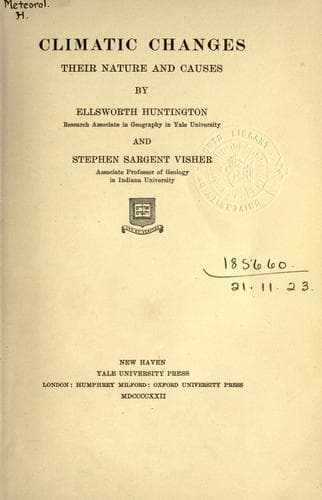
Climatic Changes: Their Nature and CausesHuntington, Ellsworth
Science
Climatic Changes: Their Nature and Causes
Huntington, Ellsworth
Climatic changes; Climatology; Paleoclimatology
In historic as well as prehistoric times, as we have already seen, there
have been climatic fluctuations. For instance, the twelfth or thirteenth
century B. C. appears to have been almost as mild as now, as does the
seventh century B. C. On the other hand about 1000 B. C., at the time of
Christ, and in the fourteenth century there were times of relative
severity. Thus it appears that both on a large and on a small scale
pulsations of climate are the rule. Any hypothesis of climatic changes
must satisfy the periods of these pulsations. These conditions furnish a
problem which makes difficulty for almost all hypotheses of climatic
change. According to the present hypothesis, earth movements such as are
discussed in Chapter XII may cooeperate with two astronomical factors.
One is the constant change in the positions of the stars, a change which
we have already called kaleidoscopic, and the other is the fact that a
large proportion of the stars are double or multiple. When one star in a
group approaches the sun closely enough to cause a great solar
disturbance, numerous others may approach or recede and have a minor
effect. Thus, whenever the sun is near groups of stars we should expect
that the earth would show many minor climatic pulsations and stages
which might or might not be connected with glaciation. The historic
pulsations shown in the curve of tree growth in California, Fig. 4, are
the sort of changes that would be expected if movements of the stars
have an effect on the solar atmosphere.
Public-domain text, read in full here on John Shaqi.
Reviews
Reviews
No reviews yet
Be the first to share your thoughts on this work.
Elsewhere in the archive
Join the Discussion
Join the discussion
Sign in to leave a comment or review.
Sign InorCreate an account