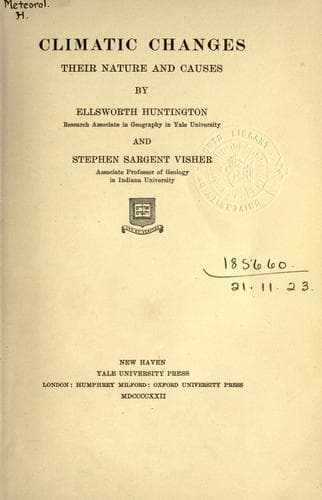
Climatic Changes: Their Nature and CausesHuntington, Ellsworth
Science
Climatic Changes: Their Nature and Causes
Huntington, Ellsworth
Climatic changes; Climatology; Paleoclimatology
In ascertaining the relation between sunspots and earthquakes it would
be well if we could employ the strict method of correlation
coefficients. This, however, is impossible for the entire century, for
the record is by no means homogeneous. The earlier decades are
represented by only about one-fourth as many earthquakes as the later
ones, a condition which is presumably due to lack of information. This
makes no difference with the method employed in Table 7, since years
with many and few sunspots are distributed almost equally throughout the
entire nineteenth century, but it renders the method of correlation
coefficients inapplicable. During the period from 1850 onward the record
is much more nearly homogeneous, though not completely so. Even in these
later decades, however, allowance must be made for the fact that there
are more earthquakes in winter than in summer, the average number per
month for the fifty years being as follows:
Jan. 2.8 May 2.4 Sept. 2.5
Feb. 2.4 June 2.3 Oct. 2.6
Mar. 2.5 July 2.4 Nov. 2.7
Apr. 2.4 Aug. 2.4 Dec. 2.8
The correlation coefficient between the departures from these monthly
averages and the corresponding departures from the monthly averages of
the sunspots for the same period, 1850-1899, are as follows:
Sunspots and earthquakes of same month: +0.042, or 1.5 times the
probable error.
Sunspots of a given month and earthquakes of that month and the
next: +0.084, or 3.1 times the probable error.
Sunspots of three consecutive months and earthquakes of three
consecutive months allowing a lag of one month, i.e., sunspots of
January, February, and March compared with earthquakes of February,
March, and April; sunspots of February, March, and April with
earthquakes of March, April, and May, etc.; +0.112, or 4.1 times the
probable error.
Public-domain text, read in full here on John Shaqi.
Reviews
Reviews
No reviews yet
Be the first to share your thoughts on this work.
Elsewhere in the archive
Join the Discussion
Join the discussion
Sign in to leave a comment or review.
Sign InorCreate an account