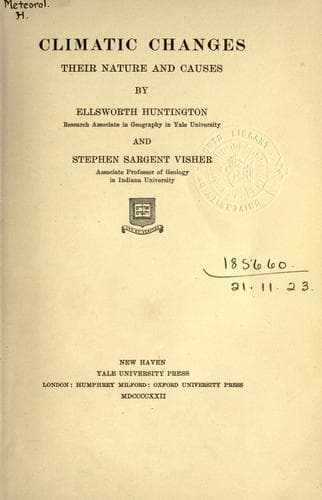
Climatic Changes: Their Nature and CausesHuntington, Ellsworth
Science
Climatic Changes: Their Nature and Causes
Huntington, Ellsworth
Climatic changes; Climatology; Paleoclimatology
These coefficients are all small, but the number of individual cases,
600 months, is so large that the probable error is greatly reduced,
being only +-0.027 or +-0.028. Moreover, the nature of our data is such
that even if there is a strong connection between solar changes and
earth movements, we should not expect a large correlation coefficient.
In the first place, as already mentioned, the earthquake data are not
strictly homogeneous. Second, an average of about two and one-half
strong earthquakes per month is at best only a most imperfect indication
of the actual movement of the earth's crust. Third, the sunspots are
only a partial and imperfect measure of the activity of the sun's
atmosphere. Fourth, the relation between solar activity and earthquakes
is almost certainly indirect. In view of all these conditions, the
regularity of Table 7 and the fact that the most important correlation
coefficient rises to more than four times the probable error makes it
almost certain that the solar and terrestrial phenomena are really
connected.
We are now confronted by the perplexing question of how this connection
can take place. Thus far only three possibilities present themselves,
and each is open to objections. The chief agencies concerned in these
three possibilities are heat, electricity, and atmospheric pressure.
Heat may be dismissed very briefly. We have seen that the earth's
surface becomes relatively cool when the sun is active. Theoretically
even the slightest change in the temperature of the earth's surface must
influence the thermal gradient far into the interior and hence cause a
change of volume which might cause movements of the crust. Practically
the heat of the surface ceases to be of appreciable importance at a
depth of perhaps twenty feet, and even at that depth it does not act
quickly enough to cause the relatively prompt response which seems to be
characteristic of earthquakes in respect to the sun.
Public-domain text, read in full here on John Shaqi.
Reviews
Reviews
No reviews yet
Be the first to share your thoughts on this work.
Elsewhere in the archive
Join the Discussion
Join the discussion
Sign in to leave a comment or review.
Sign InorCreate an account