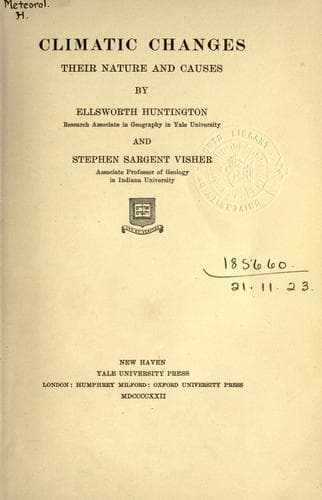
Climatic Changes: Their Nature and CausesHuntington, Ellsworth
Science
Climatic Changes: Their Nature and Causes
Huntington, Ellsworth
Climatic changes; Climatology; Paleoclimatology
The second possibility is based on the relationship between solar and
terrestrial electricity. When the sun is active the earth's atmospheric
electrical potential is subject to slight variations. It is well known
that when two opposing points of an ionized solution are oppositely
charged electrically, a current passes through the liquid and sets up
electrolysis whereby there is a segregation of materials, and a
consequent change in the volume of the parts near the respective
electrical poles. The same process takes place, although less freely, in
a hot mass such as forms the interior of the earth. The question arises
whether internal electrical currents may not pass between the two
oppositely charged poles of the earth, or even between the great
continental masses and the regions of heavier rock which underlie the
oceans. Could this lead to electrolysis, hence to differentiation in
volume, and thus to movements of the earth's crust? Could the results
vary in harmony with the sun? Bowie[127] has shown that numerous
measurements of the strength and direction of the earth's gravitative
pull are explicable only on the assumption that the upheaval of a
continent or a mountain range is due in part not merely to pressure, or
even to flowage of the rocks beneath the crust, but also to an actual
change in volume whereby the rocks beneath the continent attain
relatively great volume and those under the oceans a small volume in
proportion to their weight. The query arises whether this change of
volume may be related to electrical currents at some depth below the
earth's surface.
The objections to this hypothesis are numerous. First, there is little
evidence of electrolytic differentiation in the rocks. Second, the outer
part of the earth's crust is a very poor conductor so that it is
doubtful whether even a high degree of electrification of the surface
would have much effect on the interior. Third, electrolysis due to any
such mild causes as we have here postulated must be an extremely slow
process, too slow, presumably, to have any appreciable result within a
month or two. Other objections join with these three in making it seem
improbable that the sun's electrical activity has any direct effect upon
movements of the earth's crust.
Public-domain text, read in full here on John Shaqi.
Reviews
Reviews
No reviews yet
Be the first to share your thoughts on this work.
Elsewhere in the archive
Join the Discussion
Join the discussion
Sign in to leave a comment or review.
Sign InorCreate an account