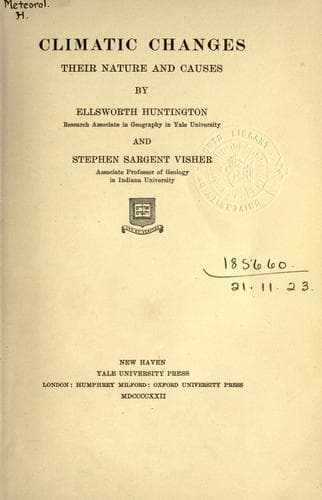
Climatic Changes: Their Nature and CausesHuntington, Ellsworth
Science
Climatic Changes: Their Nature and Causes
Huntington, Ellsworth
Climatic changes; Climatology; Paleoclimatology
Among the climatic sequences, glacial fluctuations are perhaps of the
most vital import from the standpoint of organic evolution; from the
standpoint of human history the same is true of climatic pulsations.
Glacial epochs have repeatedly wiped out thousands upon thousands of
species and played a part in the origin of entirely new types of plants
and animals. This is best seen when the life of the Pennsylvanian is
contrasted with that of the Permian. An historic pulsation may wipe out
an entire civilization and permit a new one to grow up with a radically
different character. Hence it is not strange that the causes of such
climatic phenomena have been discussed with extraordinary vigor. In few
realms of science has there been a more imposing or more interesting
array of theories. In this book we shall consider the more important of
these theories. A new solar or cyclonic hypothesis and the hypothesis of
changes in the form and altitude of the land will receive the most
attention, but the other chief hypotheses are outlined in the next
chapter, and are frequently referred to throughout the volume.
Between glacial fluctuations and historical pulsations in duration, but
probably less severe than either, come orbital precessions. These stand
in a group by themselves and are more akin to seasonal alternations than
to any other type of climatic sequence. They must have occurred with
absolute regularity ever since the earth began to revolve around the sun
in its present elliptical orbit. Since the orbit is elliptical and since
the sun is in one of the two foci of the ellipse, the earth's distance
from the sun varies. At present the earth is nearest the sun in the
northern winter. Hence the rigor of winter in the northern hemisphere is
mitigated, while that of the southern hemisphere is increased. In about
ten thousand years this condition will be reversed, and in another ten
thousand the present conditions will return once more. Such climatic
precessions, as we may here call them, must have occurred unnumbered
times in the past, but they do not appear to have been large enough to
leave in the fossils of the rocks any traces that can be distinguished
from those of other climatic sequences.
Public-domain text, read in full here on John Shaqi.
Reviews
Reviews
No reviews yet
Be the first to share your thoughts on this work.
Join the Discussion
Join the discussion
Sign in to leave a comment or review.
Sign InorCreate an account