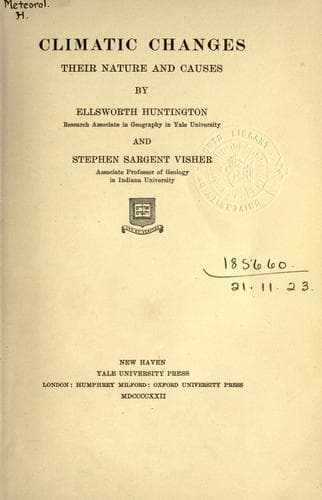
Climatic Changes: Their Nature and CausesHuntington, Ellsworth
Science
Climatic Changes: Their Nature and Causes
Huntington, Ellsworth
Climatic changes; Climatology; Paleoclimatology
We come now to Brueckner periods and sunspot cycles. The Brueckner periods
have a length of about thirty-three years. Their existence was suggested
at least as long ago as the days of Sir Francis Bacon, whose statement
about them is quoted on the flyleaf of this book. They have since been
detected by a careful study of the records of the time of harvest,
vintage, the opening of rivers to navigation, and the rise or fall of
lakes like the Caspian Sea. In his book on _Klimaschwankungen seit
1700_, Brueckner has collected an uncommonly interesting assortment of
facts as to the climate of Europe for more than two centuries. More
recently, by a study of the rate of growth of trees, Douglass, in his
book on _Climatic Cycles and Tree Growth_, has carried the subject still
further. In general the nature of the 33-year periods seems to be
identical with that of the 11- or 12- year sunspot cycle, on the one
hand, and of historic pulsations on the other. For a century observers
have noted that the variations in the weather which everyone notices
from year to year seem to have some relation to sunspots. For
generations, however, the relationship was discussed without leading to
any definite conclusion. The trouble was that the same change was
supposed to take place in all parts of the world. Hence, when every sort
of change was found somewhere at any given sunspot stage, it seemed as
though there could not be a relationship. Of late years, however, the
matter has become fairly clear. The chief conclusions are, first, that
when sunspots are numerous the average temperature of the earth's
surface is lower than normal. This does not mean that all parts are
cooler, for while certain large areas grow cool, others of less extent
become warm at times of many sunspots. Second, at times of many sunspots
storms are more abundant than usual, but are also confined somewhat
closely to certain limited tracks so that elsewhere a diminution of
storminess may be noted. This whole question is discussed so fully in
_Earth and Sun_ that it need not detain us further in this preliminary
view of the whole problem of climate. Suffice it to say that a study of
the sunspot cycle leads to the conclusion that it furnishes a clue to
many of the unsolved problems of the climate of the past, as well as a
key to prediction of the future.
Public-domain text, read in full here on John Shaqi.
Reviews
Reviews
No reviews yet
Be the first to share your thoughts on this work.
Join the Discussion
Join the discussion
Sign in to leave a comment or review.
Sign InorCreate an account