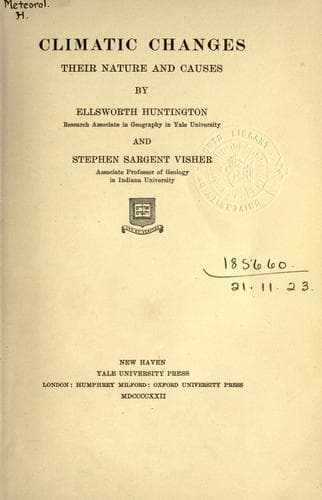
Climatic Changes: Their Nature and CausesHuntington, Ellsworth
Science
Climatic Changes: Their Nature and Causes
Huntington, Ellsworth
Climatic changes; Climatology; Paleoclimatology
I. _Croll's Eccentricity Theory._ One of the most ingenious and most
carefully elaborated scientific hypotheses is Croll's[10] precessional
hypothesis as to the effect of the earth's own motions. So well was this
worked out that it was widely accepted for a time and still finds a
place in popular but unscientific books, such as Wells' _Outline of
History_, and even in scientific works like Wright's _Quaternary Ice
Age_. The gist of the hypothesis has already been given in connection
with the type of climatic sequence known as orbital precessions. The
earth is 93 million miles away from the sun in January and 97 million in
July. The earth's axis "precesses," however, just as does that of a
spinning top. Hence arises what is known as the precession of the
equinoxes, that is, a steady change in the season at which the earth is
in perihelion, or nearest to the sun. In the course of 21,000 years the
time of perihelion varies from early in January through the entire
twelve months and back to January. Moreover, the earth's orbit is
slightly more elliptical at certain periods than at others, for the
planets sometimes become bunched so that they all pull the earth in one
direction. Hence, once in about one hundred thousand years the effect of
the elliptical shape of the earth's orbit is at a maximum.
Croll argued that these astronomical changes must alter the earth's
climate, especially by their effect on winds and ocean currents. His
elaborate argument contains a vast amount of valuable material. Later
investigation, however, seems to have proven the inadequacy of his
hypothesis. In the first place, the supposed cause does not seem nearly
sufficient to produce the observed results. Second, Croll's hypothesis
demands that glaciation in the northern and southern hemisphere take
place alternately. A constantly growing collection of facts, however,
indicates that glaciation does not occur in the two hemispheres
alternately, but at the same time. Third, the hypothesis calls for the
constant and frequent repetition of glaciation at absolutely regular
intervals. The geological record shows no such regularity, for sometimes
several glacial epochs follow in relatively close succession at
irregular intervals of perhaps fifty to two hundred thousand years, and
thus form a glacial period; and then for millions of years there are
none. Fourth, the eccentricity hypothesis provides no adequate
explanation for the glacial stages or subepochs, the historic
pulsations, and the other smaller climatic variations which are
superposed upon glacial epochs and upon one another in bewildering
confusion. In spite of these objections, there can be little question
that the eccentricity of the earth's orbit and the precession of the
equinoxes with the resulting change in the season of perihelion must
have some climatic effect. Hence Croll's theory deserves a permanent
though minor place in any full discussion of the causes of climatic
changes.
Public-domain text, read in full here on John Shaqi.
Reviews
Reviews
No reviews yet
Be the first to share your thoughts on this work.
Join the Discussion
Join the discussion
Sign in to leave a comment or review.
Sign InorCreate an account