Climatic Changes: Their Nature and Causes — John Shaqi
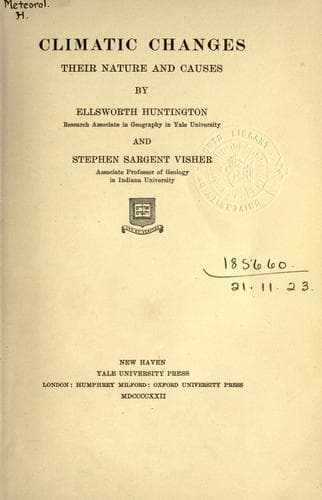
Climatic Changes: Their Nature and CausesHuntington, Ellsworth
Science
Climatic Changes: Their Nature and Causes
Huntington, Ellsworth
Climatic changes; Climatology; Paleoclimatology
II. _The Carbon Dioxide Theory._ At about the time that the eccentricity
theory was being relegated to a minor niche, a new theory was being
developed which soon exerted a profound influence upon geological
thought. Chamberlin,[11] adopting an idea suggested by Tyndall, fired
the imagination of geologists by his skillful exposition of the part
played by carbon dioxide in causing climatic changes. Today this theory
is probably more widely accepted than any other. We have already seen
that the amount of carbon dioxide gas in the atmosphere has a decided
climatic importance. Moreover, there can be little doubt that the amount
of that gas in the atmosphere varies from age to age in response to the
extent to which it is set free by volcanoes, consumed by plants,
combined with rocks in the process of weathering, dissolved in the ocean
or locked up in the form of coal and limestone. The main question is
whether such variations can produce changes so rapid as glacial epochs
and historical pulsations.
Abundant evidence seems to show that the degree to which the air can be
warmed by carbon dioxide is sharply limited. Humphreys, in his excellent
book on the _Physics of the Air_, calculates that a layer of carbon
dioxide forty centimeters thick has practically as much blanketing
effect as a layer indefinitely thicker. In other words, forty
centimeters of carbon dioxide, while having no appreciable effect on
sunlight coming toward the earth, would filter out and thus retain in
the atmosphere all the outgoing terrestrial heat that carbon dioxide is
capable of absorbing. Adding more would be like adding another filter
when the one in operation has already done all that that particular kind
of filter is capable of doing. According to Humphreys' calculations, a
doubling of the carbon dioxide in the air would in itself raise the
average temperature about 1.3 deg.C. and further carbon dioxide would have
practically no effect. Reducing the present supply by half would reduce
the temperature by essentially the same amount.
Public-domain text, read in full here on John Shaqi.
Reviews
Reviews
No reviews yet
Be the first to share your thoughts on this work.
Join the Discussion
Join the discussion
Sign in to leave a comment or review.
Sign InorCreate an account