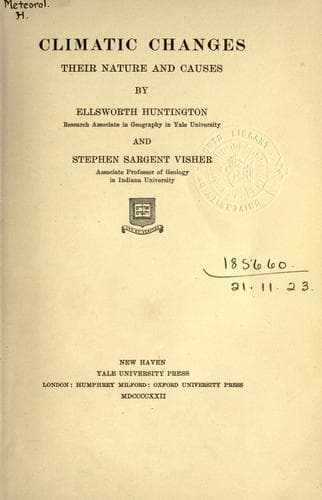
Climatic Changes: Their Nature and CausesHuntington, Ellsworth
Science
Climatic Changes: Their Nature and Causes
Huntington, Ellsworth
Climatic changes; Climatology; Paleoclimatology
The effect must be greater, however, than would appear from the figures
given above, for any change in temperature has an effect on the amount
of water vapor, which in turn causes further changes of temperature.
Moreover, as Chamberlin points out, it is not clear whether Humphreys
allows for the fact that when the 40 centimeters of CO_{2} nearest the
earth has been heated by terrestrial radiation, it in turn radiates half
its heat outward and half inward. The outward half is all absorbed in
the next layer of carbon dioxide, and so on. The process is much more
complex than this, but the end result is that even the last increment of
CO_{2}, that is, the outermost portions in the upper atmosphere, must
apparently absorb an infinitesimally small amount of heat. This fact,
plus the effect of water vapor, would seem to indicate that a doubling
or halving of the amount of CO_{2}, would have an effect of more than
1.3 deg.C. A change of even 2 deg.C. above or below the present level of the
earth's mean temperature would be of very appreciable climatic
significance, for it is commonly believed that during the height of the
glacial period the mean temperature was only 5 deg. to 8 deg.C. lower than now.
Nevertheless, variations in atmospheric carbon dioxide do not
necessarily seem competent to produce the relatively rapid climatic
fluctuations of glacial epochs and historic pulsations as distinguished
from the longer swings of glacial periods and geological eras. In
Chamberlin's view, as in ours, the elevation of the land, the
modification of the currents of the air and of the ocean, and all that
goes with elevation as a topographic agency constitute a primary cause
of climatic changes. A special effect of this is the removal of carbon
dioxide from the air by the enhanced processes of weathering. This, as
he carefully states, is a very slow process, and cannot of itself lead
to anything so sudden as the oncoming of glaciation. But here comes
Chamberlin's most distinctive contribution to the subject, namely, the
hypothesis that changes in atmospheric temperature arising from
variations in atmospheric carbon dioxide are able to cause a reversal of
the deep-sea oceanic circulation.
Public-domain text, read in full here on John Shaqi.
Reviews
Reviews
No reviews yet
Be the first to share your thoughts on this work.
Join the Discussion
Join the discussion
Sign in to leave a comment or review.
Sign InorCreate an account