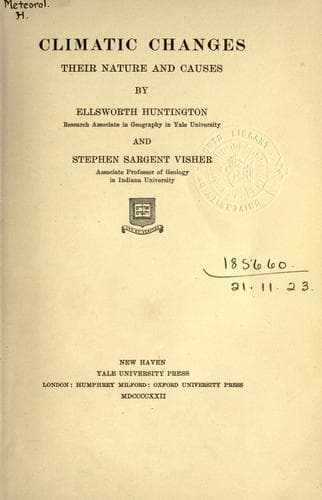
Climatic Changes: Their Nature and CausesHuntington, Ellsworth
Science
Climatic Changes: Their Nature and Causes
Huntington, Ellsworth
Climatic changes; Climatology; Paleoclimatology
Suppose that while such a reversed circulation prevailed, the
atmospheric CO_{2} should be depleted, and the air cooled so much that
the concentration of the equatorial waters by evaporation was no longer
sufficient to cause them to sink. A reversal would take place, the
present type of circulation would be inaugurated, and the whole earth
would suffer a chill because the surface of the ocean would become cool.
The cool surface-water would absorb carbon dioxide faster than the
previous warm water had done, for heat drives off gases from water. This
would hasten the cooling of the atmosphere still more, not only directly
but by diminishing the supply of atmospheric moisture. The result would
be glaciation. But ultimately the cold waters of the higher latitudes
would absorb all the carbon dioxide they could hold, the slow
equatorward creep would at length permit the cold water to rise to the
surface in low latitudes. There the warmth of the equatorial sun and the
depleted supply of carbon dioxide in the air would combine to cause the
water to give up its carbon dioxide once more. If the atmosphere had
been sufficiently depleted by that time, the rising waters in low
latitudes might give up more carbon dioxide than the cold polar waters
absorbed. Thus the atmospheric supply would increase, the air would
again grow warm, and a tendency toward deglaciation, or toward an
inter-glacial condition would arise. At such times the oceanic
circulation is not supposed to have been reversed, but merely to have
been checked and made slower by the increasing warmth. Thus
inter-glacial conditions like those of today, or even considerably
warmer, are supposed to have been produced with the present type of
circulation.
The emission of carbon dioxide in low latitudes could not permanently
exceed the absorption in high latitudes. After the present type of
circulation was finally established, which might take tens of thousands
of years, the two would gradually become equal. Then the conditions
which originally caused the oceanic circulation to be reversed would
again destroy the balance; the atmospheric carbon dioxide would be
depleted; the air would grow cooler; and the cycle of glaciation would
be repeated. Each cycle would be shorter than the last, for not only
would the swings diminish like those of a pendulum, but the agencies
that were causing the main depletion of the atmospheric carbon dioxide
would diminish in intensity. Finally as the lands became lower through
erosion and submergence, and as the processes of weathering became
correspondingly slow, the air would gradually be able to accumulate
carbon dioxide; the temperature would increase; and at length the
oceanic circulation would be reversed again. When the warm saline waters
of low latitudes finally began to sink and to set up a flow of warm
water poleward in the depths of the ocean, a glacial period would
definitely come to an end.
Public-domain text, read in full here on John Shaqi.
Reviews
Reviews
No reviews yet
Be the first to share your thoughts on this work.
Join the Discussion
Join the discussion
Sign in to leave a comment or review.
Sign InorCreate an account