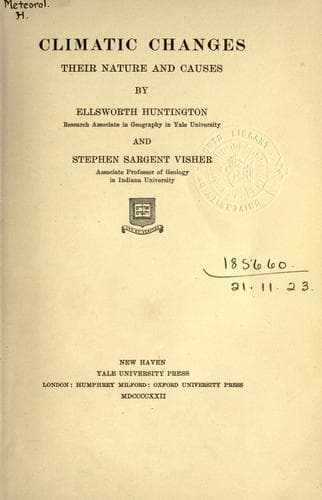
Climatic Changes: Their Nature and CausesHuntington, Ellsworth
Science
Climatic Changes: Their Nature and Causes
Huntington, Ellsworth
Climatic changes; Climatology; Paleoclimatology
This hypothesis has been so skillfully elaborated, and contains so many
important elements that one can scarcely study it without profound
admiration. We believe that it is of the utmost value as a step toward
the truth, and especially because it emphasizes the great function of
oceanic circulation. Nevertheless, we are unable to accept it in full
for several reasons, which may here be stated very briefly. Most of them
will be discussed fully in later pages.
(1) While a reversal of the deep-sea circulation would undoubtedly be of
great climatic importance and would produce a warm climate in high
latitudes, we see no direct evidence of such a reversal. It is equally
true that there is no conclusive evidence against it, and the
possibility of a reversal must not be overlooked. There seem, however,
to be other modifications of atmospheric and oceanic circulation which
are able to produce the observed results.
(2) There is much, and we believe conclusive, evidence that a mere
lowering of temperature would not produce glaciation. What seems to be
needed is changes in atmospheric circulation and in precipitation. The
carbon dioxide hypothesis has not been nearly so fully developed on the
meteorological side as in other respects.
(3) The carbon dioxide hypothesis seems to demand that the oceans should
have been almost as saline as now in the Proterozoic era at the time of
the first known glaciation. Chamberlin holds that such was the case, but
the constant supply of saline material brought to the ocean by rivers
and the relatively small deposition of such material on the sea floor
seem to indicate that the early oceans must have been much fresher than
those of today.
(4) The carbon dioxide hypothesis does not attempt to explain minor
climatic fluctuations such as post-glacial stages and historic
pulsations, but these appear to be of the same nature as glacial epochs,
differing only in degree.
(5) Another reason for hesitation in accepting the carbon dioxide
hypothesis as a full explanation of glacial fluctuations is the highly
complex and non-observational character of the explanation of the
alternation of glacial and inter-glacial epochs and of their constantly
decreasing length.
(6) Most important of all, a study of the variations of weather and of
climate as they are disclosed by present records and by the historic
past suggests that there are now in action certain other causes which
are competent to explain glaciation without recourse to a process whose
action is beyond the realm of observation.
Public-domain text, read in full here on John Shaqi.
Reviews
Reviews
No reviews yet
Be the first to share your thoughts on this work.
Join the Discussion
Join the discussion
Sign in to leave a comment or review.
Sign InorCreate an account