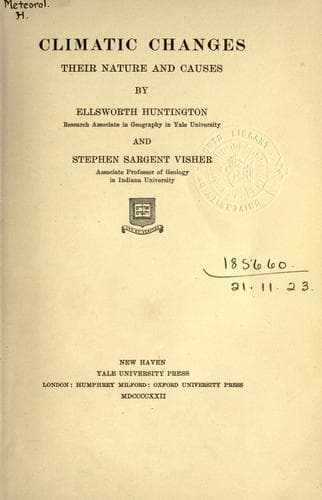
Climatic Changes: Their Nature and CausesHuntington, Ellsworth
Science
Climatic Changes: Their Nature and Causes
Huntington, Ellsworth
Climatic changes; Climatology; Paleoclimatology
In addition to this the _degree_ to which the temperature of the earth
as a whole is influenced by volcanic eruptions is by no means so clear
as is the fact that there is some influence. Arctowski,[13] for example,
has prepared numerous curves showing the march of temperature month
after month for many years. During the period from 1909 to 1913, which
includes the great eruption of Katmai in Alaska, low temperature is
found to have prevailed at the time of the eruption, but, as Arctowski
puts it, on the basis of the curves for 150 stations in all parts of the
world: "The supposition that these abnormally low temperatures were due
to the veil of volcanic dust produced by the Katmai eruption of June 6,
1912, is completely out of the question. If that had been the case,
temperature would have decreased from that date on, whereas it was
decreasing for more than a year before that date."
Koeppen,[14] in his comprehensive study of temperature for a hundred
years, also presents a strong argument against the idea that volcanic
eruptions have an important place in determining the present temperature
of the earth. A volcanic eruption is a sudden occurrence. Whatever
effect is produced by dust thrown into the air must occur within a few
months, or as soon as the dust has had an opportunity to be wafted to
the region in question. When the dust arrives, there will be a rapid
drop through the few degrees of temperature which the dust is supposed
to be able to account for, and thereafter a slow rise of temperature. If
volcanic eruptions actually caused a frequent lowering of terrestrial
temperature in the hundred years studied by Koeppen, there should be more
cases where the annual temperature is decidedly below the normal than
where it shows a large departure in the opposite direction. The contrary
is actually the case.
A still more important argument is the fact that the earth is now in an
intermediate condition of climate. Throughout most of geologic time, as
we shall see again and again, the climate of the earth has been milder
than now. Regions like Greenland have not been the seat of glaciers, but
have been the home of types of plants which now thrive in relatively low
latitudes. In other words, the earth is today only part way from a
glacial epoch to what may be called the normal, mild climate of the
earth--a climate in which the contrast from zone to zone was much less
than now, and the lower air averaged warmer. Hence it seems impossible
to avoid the conclusion that the cause of glaciation is still operating
with considerable although diminished efficiency. But volcanic dust is
obviously not operating to any appreciable extent at present, for the
upper air is almost free from dust a large part of the time.
Public-domain text, read in full here on John Shaqi.
Reviews
Reviews
No reviews yet
Be the first to share your thoughts on this work.
Join the Discussion
Join the discussion
Sign in to leave a comment or review.
Sign InorCreate an account