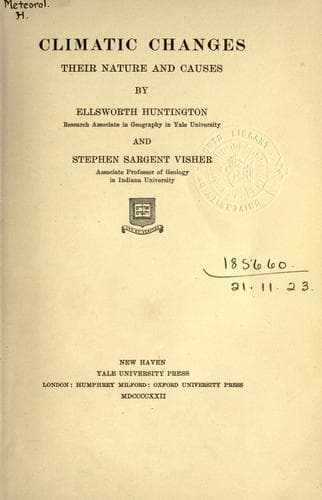
Climatic Changes: Their Nature and Causes — John Shaqi
Climatic Changes: Their Nature and CausesHuntington, Ellsworth
Science
Climatic Changes: Their Nature and Causes
Huntington, Ellsworth
Climatic changes; Climatology; Paleoclimatology
IV. _The Volcanic Hypothesis._ In the search for some cause of climatic
change which is highly efficient and yet able to vary rapidly and
independently, Abbot, Fowle, Humphreys, and others,[12] have concluded
that volcanic eruptions are the missing agency. In _Physics of the Air_,
Humphreys gives a careful study of the effect of volcanic dust upon
terrestrial temperature. He begins with a mathematical investigation of
the size of dust particles, and their quantity after certain eruptions.
He demonstrates that the power of such particles to deflect light of
short wave-lengths coming from the sun is perhaps thirty times more than
their power to retain the heat radiated in long waves from the earth.
Hence it is estimated that if a Krakatoa were to belch forth dust every
year or two, the dust veil might cause a reduction of about 6 deg.C. in the
earth's surface temperature. As in every such complicated problem, some
of the author's assumptions are open to question, but this touches their
quantitative and not their qualitative value. It seems certain that if
volcanic explosions were frequent enough and violent enough, the
temperature of the earth's surface would be considerably lowered.
Actual observation supports this theoretical conclusion. Humphreys
gathers together and amplifies all that he and Abbot and Fowle have
previously said as to observations of the sun's thermal radiation by
means of the pyrheliometer. This summing up of the relations between the
heat received from the sun, and the occurrence of explosive volcanic
eruptions leaves little room for doubt that at frequent intervals during
the last century and a half a slight lowering of terrestrial temperature
has actually occurred after great eruptions. Nevertheless, it does not
justify Humphreys' final conclusion that "phenomena within the earth
itself suffice to modify its own climate, ... that these and these alone
have actually caused great changes time and again in the geologic past."
Humphreys sees so clearly the importance of the purely terrestrial point
of view that he unconsciously slights the cosmic standpoint and ignores
the important solar facts which he himself adduces elsewhere at
considerable length.
Public-domain text, read in full here on John Shaqi.
Reviews
Reviews
No reviews yet
Be the first to share your thoughts on this work.
Join the Discussion
Join the discussion
Sign in to leave a comment or review.
Sign InorCreate an account