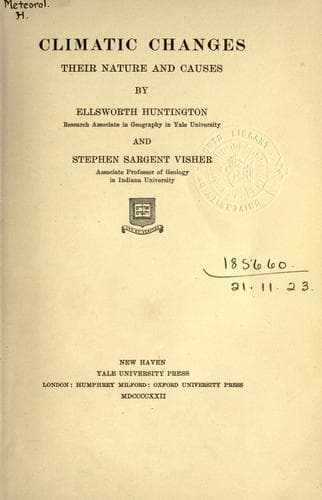
Climatic Changes: Their Nature and CausesHuntington, Ellsworth
Science
Climatic Changes: Their Nature and Causes
Huntington, Ellsworth
Climatic changes; Climatology; Paleoclimatology
Since the planetary influences vary in
strength because of the continuous change in the relative distances and
positions of the planets, the sun's atmosphere appears to be swayed by
cyclonic disturbances of varying degrees of severity. The cyclonic
disturbances known as sunspots have been proved by Hale to become more
highly electrified as they increase in intensity. At the same time hot
gases presumably well up from the lower parts of the solar atmosphere
and thereby cause the sun to emit more heat. Thus by one means or
another, the earth's atmosphere appears to be set in commotion and
cycles of climate are inaugurated.
If the preceding reasoning is correct, any disturbance of the solar
atmosphere must have an effect upon the earth's climate. If the
disturbance were great enough and of the right nature it might produce a
glacial epoch. The planets are by no means the only bodies which act
upon the sun, for that body sustains a constantly changing relation to
millions of other celestial bodies of all sizes up to vast universes,
and at all sorts of distances. If the sun and another star should
approach near enough to one another, it is certain that the solar
atmosphere would be disturbed much more than at present.
Here we must leave the cyclonic hypothesis of climate and must refer the
reader once more to _Earth and Sun_ for fuller details. In the rest of
this book we shall discuss the nature of the climatic changes of past
times and shall inquire into their relation to the various climatic
hypotheses mentioned in the last two chapters. Then we shall inquire
into the possibility that the solar system has ever been near enough to
any of the stars to cause appreciable disturbances of the solar
atmosphere. We shall complete our study by investigating the vexed
question of why movements of the earth's crust, such as the uplifting of
continents and mountain chains, have generally occurred at the same time
as great climatic fluctuations. This would not be so surprising were it
not that the climatic phenomena appear to have consisted of highly
complex cycles while the uplift has been a relatively steady movement in
one direction. We shall find some evidence that the solar disturbances
which seem to cause climatic changes also have a relation to movements
of the crust.
FOOTNOTES:
[Footnote 15: The so-called sunspot numbers to which reference is made
again and again in this book are based on a system devised by Wolf and
revised by A. Wolfer. The number and size of the spots are both taken
into account. The numbers from 1749 to 1900 may be found in the Monthly
Weather Review for April, 1902, and from 1901 to 1918 in the same
journal for 1920.]
CHAPTER V
THE CLIMATE OF HISTORY[16]
Public-domain text, read in full here on John Shaqi.
Reviews
Reviews
No reviews yet
Be the first to share your thoughts on this work.
Join the Discussion
Join the discussion
Sign in to leave a comment or review.
Sign InorCreate an account