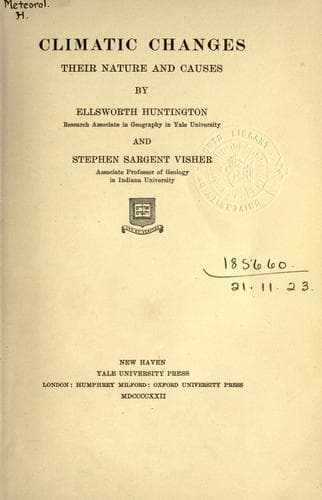
Climatic Changes: Their Nature and CausesHuntington, Ellsworth
Science
Climatic Changes: Their Nature and Causes
Huntington, Ellsworth
Climatic changes; Climatology; Paleoclimatology
We are now prepared to consider the climate of the past. The first
period to claim attention is the few thousand years covered by written
history. Strangely enough, the conditions during this time are known
with less accuracy than are those of geological periods hundreds of
times more remote. Yet if pronounced changes have occurred since the
days of the ancient Babylonians and since the last of the post-glacial
stages, they are of great importance not only because of their possible
historic effects, but because they bridge the gap between the little
variations of climate which are observable during a single lifetime and
the great changes known as glacial epochs. Only by bridging the gap can
we determine whether there is any genetic relation between the great
changes and the small. A full discussion of the climate of historic
times is not here advisable, for it has been considered in detail in
numerous other publications.[17] Our most profitable course would seem
to be to consider first the general trend of opinion and then to take up
the chief objections to each of the main hypotheses.
In the hot debate over this problem during recent decades the ideas of
geographers seem to have gone through much the same metamorphosis as
have those of geologists in regard to the climate of far earlier times.
As every geologist well knows, at the dawn of geology people believed in
climatic uniformity--that is, it was supposed that since the completion
of an original creative act there had been no important changes. This
view quickly disappeared and was superseded by the hypothesis of
progressive cooling and drying, an hypothesis which had much to do with
the development of the nebular hypothesis, and which has in turn been
greatly strengthened by that hypothesis. The discovery of evidence of
widespread continental glaciation, however, necessitated a modification
of this view, and succeeding years have brought to light a constantly
increasing number of glacial, or at least cool, periods distributed
throughout almost the whole of geological time. Moreover, each year,
almost, brings new evidence of the great complexity of glacial periods,
epochs, and stages. Thus, for many decades, geologists have more and
more been led to believe that in spite of surprising uniformity, when
viewed in comparison with the cosmic possibilities, the climate of the
past has been highly unstable from the viewpoint of organic evolution,
and its changes have been of all degrees of intensity.
Public-domain text, read in full here on John Shaqi.
Reviews
Reviews
No reviews yet
Be the first to share your thoughts on this work.
Join the Discussion
Join the discussion
Sign in to leave a comment or review.
Sign InorCreate an account