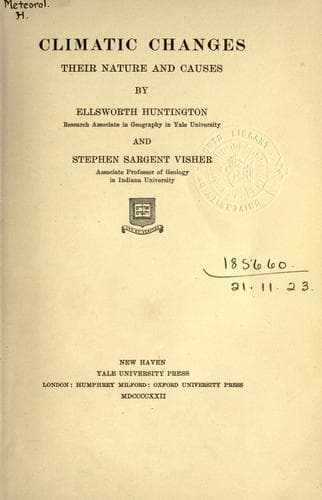
Climatic Changes: Their Nature and CausesHuntington, Ellsworth
Science
Climatic Changes: Their Nature and Causes
Huntington, Ellsworth
Climatic changes; Climatology; Paleoclimatology
Geographers have lately been debating the reality of historic changes of
climate in the same way in which geologists debated the reality of
glacial epochs and stages. Several hypotheses present themselves but
these may all be grouped under three headings; namely, the hypotheses of
(1) progressive desiccation, (2) climatic uniformity, and (3)
pulsations. The hypothesis of progressive desiccation has been widely
advocated. In many of the drier portions of the world, especially
between 30 deg. and 40 deg. from the equator, and preeminently in western and
central Asia and in the southwestern United States, almost innumerable
facts seem to indicate that two or three thousand years ago the climate
was distinctly moister than at present. The evidence includes old lake
strands, the traces of desiccated springs, roads in places now too dry
for caravans, other roads which make detours around dry lake beds where
no lakes now exist, and fragments of dead forests extending over
hundreds of square miles where trees cannot now grow for lack of water.
Still stronger evidence is furnished by ancient ruins, hundreds of which
are located in places which are now so dry that only the merest fraction
of the former inhabitants could find water. The ruins of Palmyra, in the
Syrian Desert, show that it must once have been a city like modern
Damascus, with one or two hundred thousand inhabitants, but its water
supply now suffices for only one or two thousand. All attempts to
increase the water supply have had only a slight effect and the water is
notoriously sulphurous, whereas in the former days, when it was
abundant, it was renowned for its excellence. Hundreds of pages might be
devoted to describing similar ruins. Some of them are even more
remarkable for their dryness than is Niya, a site in the Tarim Desert of
Chinese Turkestan. Yet there the evidence of desiccation within 2000
years is so strong that even so careful and conservative a man as
Hann,[18] pronounces it "ueberzeugend."
A single quotation from scores that might be used will illustrate the
conclusions of some of the most careful archaeologists.[19]
Public-domain text, read in full here on John Shaqi.
Reviews
Reviews
No reviews yet
Be the first to share your thoughts on this work.
Join the Discussion
Join the discussion
Sign in to leave a comment or review.
Sign InorCreate an account