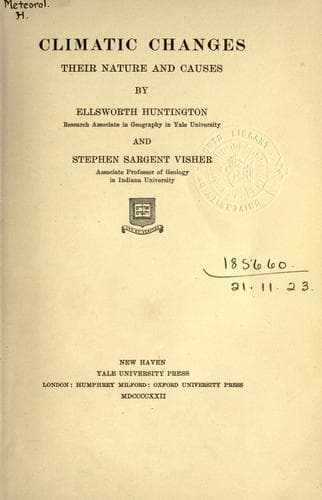
Climatic Changes: Their Nature and CausesHuntington, Ellsworth
Science
Climatic Changes: Their Nature and Causes
Huntington, Ellsworth
Climatic changes; Climatology; Paleoclimatology
The traveler who has crossed the settled, and more or less
populous, coast range of northern Syria and descended into the
narrow fertile valley of the Orontes, encounters in any farther
journey toward the east an irregular range of limestone hills lying
north and south and stretching to the northeast almost halfway to
the Euphrates. These hills are about 2,500 feet high, rising in
occasional peaks from 3,000 to 3,500 feet above sea level. They are
gray and unrelieved by any visible vegetation. On ascending into
the hills the traveler is astonished to find at every turn remnants
of the work of men's hands, paved roads, walls which divided
fields, terrace walls of massive structure. Presently he comes upon
a small deserted and partly ruined town composed of buildings large
and small constructed of beautifully wrought blocks of limestone,
all rising out of the barren rock which forms the ribs of the
hills. If he mounts an eminence in the vicinity, he will be still
further astonished to behold similar ruins lying in all directions.
He may count ten or fifteen or twenty, according to the commanding
position of his lookout. From a distance it is often difficult to
believe that these are not inhabited places; but closer inspection
reveals that the gentle hand of time or the rude touch of
earthquake has been laid upon every building. Some of the towns are
better preserved than others; some buildings are quite perfect but
for their wooden roofs which time has removed, others stand in
picturesque ruins, while others still are level with the ground. On
a far-off hilltop stands the ruin of a pagan temple, and crowning
some lofty ridge lie the ruins of a great Christian monastery. Mile
after mile of this barren gray country may be traversed without
encountering a single human being. Day after day may be spent in
traveling from one ruined town to another without seeing any green
thing save a terebinth tree or two standing among the ruins, which
have sent their roots down into earth still preserved in the
foundations of some ancient building. No soil is visible anywhere
except in a few pockets in the rock from which it could not be
washed by the torrential rains of the wet season; yet every ruin is
surrounded with the remains of presses for the making of oil and
wine. Only one oasis has been discovered in these high plateaus.
Public-domain text, read in full here on John Shaqi.
Reviews
Reviews
No reviews yet
Be the first to share your thoughts on this work.
Join the Discussion
Join the discussion
Sign in to leave a comment or review.
Sign InorCreate an account