Climatic Changes: Their Nature and Causes — John Shaqi
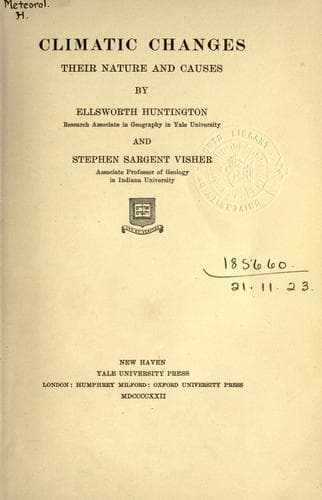
Climatic Changes: Their Nature and CausesHuntington, Ellsworth
Science
Climatic Changes: Their Nature and Causes
Huntington, Ellsworth
Climatic changes; Climatology; Paleoclimatology
Passing eastward from this range of hills, one descends into a
gently rolling country that stretches miles away toward the
Euphrates. At the eastern foot of the hills one finds oneself in a
totally different country, at first quite fertile and dotted with
frequent villages of flat-roofed houses. Here practically all the
remains of ancient times have been destroyed through ages of
building and rebuilding. Beyond this narrow fertile strip the soil
grows drier and more barren, until presently another kind of desert
is reached, an undulating waste of dead soil. Few walls or towers
or arches rise to break the monotony of the unbroken landscape; but
the careful explorer will find on closer examination that this
region was more thickly populated in antiquity even than the hill
country to the west. Every unevenness of the surface marks the site
of a town, some of them cities of considerable extent.
We may draw certain very definite conclusions as to the former
conditions of the country itself. There was soil upon the northern
hills where none now exists, for the buildings now show unfinished
foundation courses which were not intended to be seen; the soil in
depressions without outlets is deeper than it formerly was; there
are hundreds of olive and wine presses in localities where no tree
or vine could now find footing; and there are hillsides with ruined
terrace walls rising one above the other with no sign of earth near
them. There was also a large natural water supply. In the north as
well as in the south we find the dry beds of rivers, streams, and
brooks with sand and pebbles and well-worn rocks but no water in
them from one year's end to the other. We find bridges over these
dry streams and crudely made washing boards along their banks
directly below deserted towns. Many of the bridges span the beds of
streams that seldom or never have water in them and give clear
evidence of the great climatic changes that have taken place. There
are well heads and well houses, and inscriptions referring to
springs; but neither wells nor springs exist today except in the
rarest instances. Many of the houses had their rock-hewn cisterns,
never large enough to have supplied water for more than a brief
period, and corresponding to the cisterns which most of our recent
forefathers had which were for convenience rather than for
dependence. Some of the towns in southern Syria were provided with
large public reservoirs, but these are not large enough to have
supplied water to their original populations. The high plateaus
were of course without irrigation; but there are no signs, even in
the lower flatter country, that irrigation was ever practiced; and
canals for this purpose could not have completely disappeared.
Public-domain text, read in full here on John Shaqi.
Reviews
Reviews
No reviews yet
Be the first to share your thoughts on this work.
Join the Discussion
Join the discussion
Sign in to leave a comment or review.
Sign InorCreate an account