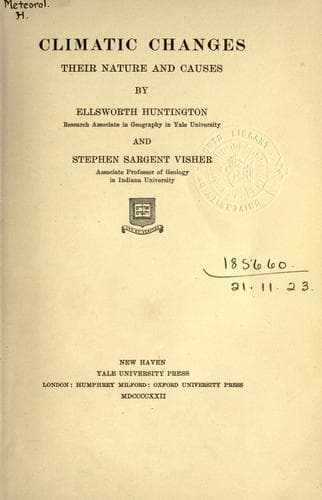
Climatic Changes: Their Nature and Causes — John Shaqi
Climatic Changes: Their Nature and CausesHuntington, Ellsworth
Science
Climatic Changes: Their Nature and Causes
Huntington, Ellsworth
Climatic changes; Climatology; Paleoclimatology
The considerations which have just been set forth have led to a third
hypothesis, that of pulsatory climatic changes. According to this, the
earth's climate is not stable, nor does it change uniformly in one
direction. It appears to fluctuate back and forth not only in the little
waves which we see from year to year or decade to decade, but in much
larger waves, which take hundreds of years or even a thousand. These in
turn seem to merge into and be imposed on the greater waves which form
glacial stages, glacial epochs, and glacial periods. At the present time
there seems to be no way of determining whether the general tendency is
toward aridity or toward glaciation. The seventh century of our era was
apparently the driest time during the historic period--distinctly drier
than the present--but the thirteenth century was almost equally dry, and
the twelfth or thirteenth before Christ may have been very dry.
The best test of an hypothesis is actual measurements. In the case of
the pulsatory hypothesis we are fortunately able to apply this test by
means of trees. The growth of vegetation depends on many factors--soil,
exposure, wind, sun, temperature, rain, and so forth. In a dry region
the most critical factor in determining how a tree's growth shall vary
from year to year is the supply of moisture during the few months of
most rapid growth.[22] The work of Douglass[23] and others has shown
that in Arizona and California the thickness of the annual rings affords
a reliable indication of the amount of moisture available during the
period of growth. This is especially true when the growth of several
years is taken as the unit and is compared with the growth of a similar
number of years before or after. Where a long series of years is used,
it is necessary to make corrections to eliminate the effects of age, but
this can be done by mathematical methods of considerable accuracy. It is
difficult to determine whether the climate at the beginning and end of a
tree's life was the same, but it is easily possible to determine whether
there have been pulsations while the tree was making its growth. If a
large number of trees from various parts of a given district all formed
thick rings at a certain period and then formed thin ones for a hundred
years, after which the rings again become thick, we seem to be safe in
concluding that the trees have lived through a long, dry period. The
full reasons for this belief and details as to the methods of estimating
climate from tree growth are given in _The Climatic Factor_.
Public-domain text, read in full here on John Shaqi.
Reviews
Reviews
No reviews yet
Be the first to share your thoughts on this work.
Join the Discussion
Join the discussion
Sign in to leave a comment or review.
Sign InorCreate an account