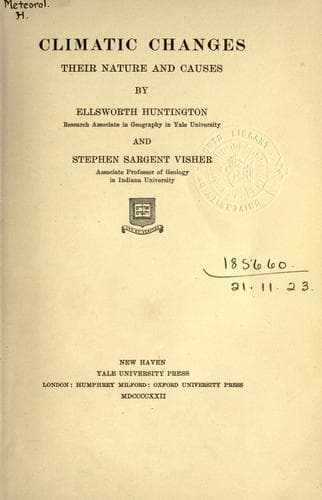
Climatic Changes: Their Nature and CausesHuntington, Ellsworth
Science
Climatic Changes: Their Nature and Causes
Huntington, Ellsworth
Climatic changes; Climatology; Paleoclimatology
Many observers, quite as careful as those who believe in progressive
desiccation, point to evidences of aridity in past times in the very
regions where the others find proof of moisture. Lakes such as the
Caspian Sea fell to such a low level that parts of their present floors
were exposed and were used as sites for buildings whose ruins are still
extant. Elsewhere, for instance in the Tian-Shan Mountains, irrigation
ditches are found in places where irrigation never seems to be necessary
at present. In Syria and North Africa during the early centuries of the
Christian era the Romans showed unparalleled activity in building great
aqueducts and in watering land which then apparently needed water almost
as much as it does today. Evidence of this sort is abundant and is as
convincing as is the evidence of moister conditions in the past. It is
admirably set forth, for example, in the comprehensive and ably written
monograph of Leiter on the climate of North Africa.[21] The evidence
cited there and elsewhere has led many authors strongly to advocate the
hypothesis of climatic uniformity. They have done exactly as have the
advocates of progressive change, and have extended their conclusions
over the whole world and over the whole of historic times.
The hypotheses of climatic uniformity and of progressive change both
seem to be based on reliable evidence. They may seem to be diametrically
opposed to one another, but this is only when there is a failure to
group the various lines of evidence according to their dates, and
according to the types of climate in which they happen to be located.
When the facts are properly grouped in both time and space, it appears
that evidence of moist conditions in the historic Mediterranean lands is
found during certain periods; for instance, four or five hundred years
before Christ, at the time of Christ, and 1000 A. D. The other kind of
evidence, on the contrary, culminates at other epochs, such as about
1200 B. C. and in the seventh and thirteenth centuries after Christ. It
is also found during the interval from the culmination of a moist epoch
to the culmination of a dry one, for at such times the climate was
growing drier and the people were under stress. This was seemingly the
case during the period from the second to the fourth centuries of our
era. North Africa and Syria must then have been distinctly better
watered than at present, as appears from Butler's vivid description; but
they were gradually becoming drier, and the natural effect on a
vigorous, competent people like the Romans was to cause them to
construct numerous engineering works to provide the necessary water.
Public-domain text, read in full here on John Shaqi.
Reviews
Reviews
No reviews yet
Be the first to share your thoughts on this work.
Join the Discussion
Join the discussion
Sign in to leave a comment or review.
Sign InorCreate an account