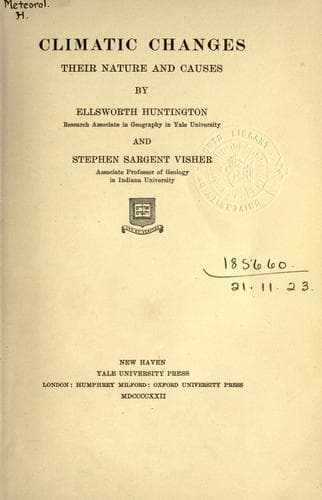
Climatic Changes: Their Nature and CausesHuntington, Ellsworth
Science
Climatic Changes: Their Nature and Causes
Huntington, Ellsworth
Climatic changes; Climatology; Paleoclimatology
During this same unfortunate first half of the fourteenth century
England also suffered from conditions which, if sufficiently
intensified, might be those of a glacial period. According to Thorwald
Rogers[33] the severest famine ever experienced in England was that of
1315-1316, and the next worst was in 1321. In fact, from 1308 to 1322
great scarcity of food prevailed most of the time. Other famines of less
severity occurred in 1351 and 1369. "The same cause was at work in all
these cases," says Rogers, "incessant rain, and cold, stormy summers. It
is said that the inclemency of the seasons affected the cattle, and that
numbers perished from disease and want." After the bad harvest of 1315
the price of wheat, which was already high, rose rapidly, and in May,
1316, was about five times the average. For a year or more thereafter it
remained at three or four times the ordinary level. The severity of the
famine may be judged from the fact that previous to the Great War the
most notable scarcity of wheat in modern England and the highest
relative price was in December, 1800. At that time wheat cost nearly
three times the usual amount, instead of five as in 1316. During the
famine of the early fourteenth century "it is said that people were
reduced to subsist upon roots, upon horses and dogs, and stories are
told of even more terrible acts by reason of the extreme famine." The
number of deaths was so great that the price of labor suffered a
permanent rise of at least 10 per cent. There simply were not people
enough left among the peasants to do the work demanded by the more
prosperous class who had not suffered so much.
After the famine came drought. The year 1325 appears to have been
peculiarly dry, and 1331, 1344, 1362, 1374, and 1377 were also dry. In
general these conditions do little harm in England. They are of interest
chiefly as showing how excessive rain and drought are apt to succeed one
another.
Public-domain text, read in full here on John Shaqi.
Reviews
Reviews
No reviews yet
Be the first to share your thoughts on this work.
Elsewhere in the archive
Join the Discussion
Join the discussion
Sign in to leave a comment or review.
Sign InorCreate an account