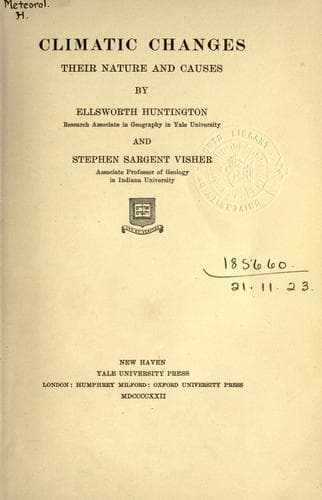
Climatic Changes: Their Nature and CausesHuntington, Ellsworth
Science
Climatic Changes: Their Nature and Causes
Huntington, Ellsworth
Climatic changes; Climatology; Paleoclimatology
These facts regarding northern and central Europe during the fourteenth
century are particularly significant when compared with the conclusions
which we have drawn in _Earth and Sun_ from the growth of trees in
Germany and from the distribution of storms. A careful study of all the
facts shows that we are dealing with two distinct types of phenomena. In
the first place, the climate of central Europe seems to have been
peculiarly continental during the fourteenth century. The winters were
so cold that the rivers froze, and the summers were so wet that there
were floods every other year or oftener. This seems to be merely an
intensification of the conditions which prevail at the present time
during periods of many sunspots, as indicated by the growth of trees at
Eberswalde in Germany and by the number of storms in winter as compared
with summer. The prevalence of droughts, especially in the spring, is
also not inconsistent with the existence of floods at other seasons, for
one of the chief characteristics of a continental climate is that the
variations from one season to another are more marked than in oceanic
climates. Even the summer droughts are typically continental, for when
continental conditions prevail, the difference between the same season
in different years is extreme, as is well illustrated in Kansas. It must
always be remembered that what causes famine is not so much absolute
dryness as a temporary diminution of the rainfall.
The second type of phenomena is peculiarly oceanic in character. It
consists of two parts, both of which are precisely what would be
expected if a highly continental climate prevailed over the land. In the
first place, at certain times the cold area of high pressure, which is
the predominating characteristic of a continent during the winter,
apparently spread out over the neighboring oceans. Under such conditions
an inland sea, such as the Baltic, would be frozen, so that horses could
cross the ice even in the Far West. In the second place, because of the
unusually high pressure over the continent, the barometric gradients
apparently became intensified. Hence at the margin of the continental
high-pressure area the winds were unusually strong and the storms of
corresponding severity. Some of these storms may have passed entirely
along oceanic tracks, while others invaded the borders of the land, and
gave rise to the floods and to the wearing away of the coast described
by Pettersson.
Turning now to the east of Europe, Brueckner's[34] study of the Caspian
Sea shows that that region as well as western Europe was subject to
great climatic vicissitudes in the first half of the fourteenth century.
In 1306-1307 the Caspian Sea, after rising rapidly for several years,
stood thirty-seven feet above the present level and it probably rose
still higher during the succeeding decades. At least it remained at a
high level, for Hamdulla, the Persian, tells us that in 1325 a place
called Aboskun was under water.[35]
Public-domain text, read in full here on John Shaqi.
Reviews
Reviews
No reviews yet
Be the first to share your thoughts on this work.
Elsewhere in the archive
Join the Discussion
Join the discussion
Sign in to leave a comment or review.
Sign InorCreate an account