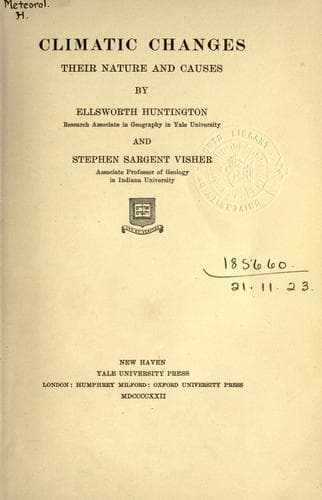
Climatic Changes: Their Nature and CausesHuntington, Ellsworth
Science
Climatic Changes: Their Nature and Causes
Huntington, Ellsworth
Climatic changes; Climatology; Paleoclimatology
Still further east the inland lake of Lop Nor also rose at about this
time. According to a Chinese account the Dragon Town on the shore of Lop
Nor was destroyed by a flood. From Himley's translation it appears that
the level of the lake rose so as to overwhelm the city completely. This
would necessitate the expansion of the lake to a point eighty miles east
of Lulan, and fully fifty from the present eastern end of the Kara
Koshun marsh. The water would have to rise nearly, or quite, to a strand
which is now clearly visible at a height of twelve feet above the modern
lake or marsh.
In India the fourteenth century was characterized by what appears to
have been the most disastrous drought in all history. Apparently the
decrease in rainfall here was as striking as the increase in other parts
of the world. No statistics are available but we are told that in the
great famine which began in 1344 even the Mogul emperor was unable to
obtain the necessaries of life for his household. No rain worth
mentioning fell for years. In some places the famine lasted three or
four years, and in some twelve, and entire cities were left without an
inhabitant. In a later famine, 1769-1770, which occurred in Bengal
shortly after the foundation of British rule in India, but while the
native officials were still in power, a third of the population, or ten
out of thirty millions, perished. The famine in the first half of the
fourteenth century seems to have been far worse. These Indian famines
were apparently due to weak summer monsoons caused presumably by the
failure of central Asia to warm up as much as usual. The heavier
snowfall, and the greater cloudiness of the summer there, which probably
accompanied increased storminess, may have been the reason.
Public-domain text, read in full here on John Shaqi.
Reviews
Reviews
No reviews yet
Be the first to share your thoughts on this work.
Elsewhere in the archive
Join the Discussion
Join the discussion
Sign in to leave a comment or review.
Sign InorCreate an account