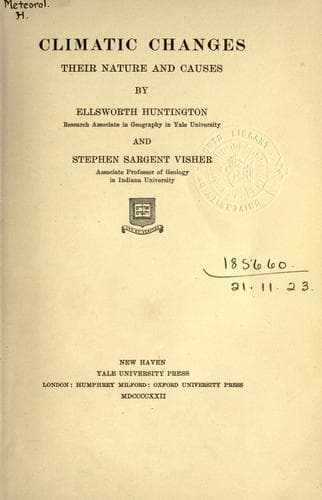
Climatic Changes: Their Nature and CausesHuntington, Ellsworth
Science
Climatic Changes: Their Nature and Causes
Huntington, Ellsworth
Climatic changes; Climatology; Paleoclimatology
The New World as well as the Old appears to have been in a state of
climatic stress during the first half of the fourteenth century.
According to Pettersson, Greenland furnishes an example of this. At
first the inhabitants of that northland were fairly prosperous and were
able to approach from Iceland without much hindrance from the ice. Today
the North Atlantic Ocean northeast of Iceland is full of drift ice much
of the time. The border of the ice varies from season to season, but in
general it extends westward from Iceland not far from the Arctic circle
and then follows the coast of Greenland southward to Cape Farewell at
the southern tip and around to the western side for fifty miles or more.
Except under exceptional circumstances a ship cannot approach the coast
until well northward on the comparatively ice-free west coast. In the
old Sagas, however, nothing is said of ice in this region. The route
from Iceland to Greenland is carefully described. In the earliest times
it went from Iceland a trifle north of west so as to approach the coast
of Greenland after as short an ocean passage as possible. Then it went
down the coast in a region where approach is now practically impossible
because of the ice. At that time this coast was icy close to the shore,
but there is no sign that navigation was rendered difficult as is now
the case. Today no navigator would think of keeping close inland. The
old route also went _north_ of the island on which Cape Farewell is
located, although the narrow channel between the island and the mainland
is now so blocked with ice that no modern vessel has ever penetrated it.
By the thirteenth century, however, there appears to have been a change.
In the Kungaspegel or _Kings' Mirror_, written at that time, navigators
are warned not to make the east coast too soon on account of ice, but no
new route is recommended in the neighborhood of Cape Farewell or
elsewhere. Finally, however, at the end of the fourteenth century,
nearly 150 years after the Kungaspegel, the old sailing route was
abandoned, and ships from Iceland sailed directly southwest to avoid the
ice. As Pettersson says:
... At the end of the thirteenth and the beginning of the fourteenth
century the European civilization in Greenland was wiped out by an
invasion of the aboriginal population. The colonists in the
Vesterbygd were driven from their homes and probably migrated to
America leaving behind their cattle in the fields. So they were
found by Ivar Bardsson, steward to the Bishop of Gardar, in his
official journey thither in 1342.
Public-domain text, read in full here on John Shaqi.
Reviews
Reviews
No reviews yet
Be the first to share your thoughts on this work.
Elsewhere in the archive
Join the Discussion
Join the discussion
Sign in to leave a comment or review.
Sign InorCreate an account